Seoul: Samsung Electronics Co. plans to use its in-house Exynos mobile processor in upcoming Galaxy S26 smartphone models, industry sources said. The company’s System Large Scale Integration (LSI) division, a fabless unit that focuses on designing and developing advanced system-on-chip (SoC) products, has completed development of the latest Exynos 2600 chip and will supply it for parts of the Galaxy S26 series starting in November, according to the sources, reports Yonhap news agency. Exynos chipsets are designed and produced by Samsung Electronics’ semiconductor business. According to the sources, the company’s in-house tests show strong performance from the Exynos 2600 compared with competitors, and the company believes the chip compares favorably with Apple Inc.’s A19 Pro used in the iPhone 17 Pro models. The Exynos 2600 is expected to appear in at least one Galaxy S26 model, anticipated to be unveiled early next year. If the top-tier Galaxy S26 Ultra uses an Exynos chip, it would be the first Ultra model to include an in-house processor since the Galaxy S22 series in 2022. Add Zee News as a Preferred Source Previously, Samsung Electronics used Qualcomm Inc.’s Snapdragon chipsets across all Galaxy S23 models, while Exynos appeared only in some S24 variants. The Galaxy S25, S25 Plus and S25 Ultra, launched earlier this year, all use Qualcomm Snapdragon chips. Meanwhile, the launch of the new generation Galaxy S26 series models in India is expected next year in January or March. According to multiple reports and industry watchers, the model is slated to compete with several flagships in the market, including the iPhone 17 Pro Max. If reports can be believed, the price of the upcoming Samsung Galaxy S26 Ultra 5G mobile in India is expected to be around Rs 1,59,999 for the base model. There is also buzz doing rounds that it may offer 12GB of RAM with 3 storage options of 256GB, 512GB, and 1TB. However, industry watchers expect that the official pricing will be based on the storage variants.
The Complete Guide to Vector Databases for Machine Learning
In this article, you will learn how vector databases power fast, scalable similarity search for modern machine learning applications and when to use them effectively. Topics we will cover include: Why conventional database indexing breaks down for high-dimensional embeddings. The core ANN index families (HNSW, IVF, PQ) and their trade-offs. Production concerns: recall vs. latency tuning, scaling, filtering, and vendor choices. Let’s get started! The Complete Guide to Vector Databases for Machine LearningImage by Author Introduction Vector databases have become essential in most modern AI applications. If you’ve built anything with embeddings — semantic search, recommendation engines, RAG systems — you’ve likely hit the wall where traditional databases don’t quite suffice. Building search applications sounds straightforward until you try to scale. When you move from a prototype to real data with millions of documents and hundreds of millions of vectors, you hit a roadblock. Each search query compares your input against every vector in your database. With 1024- or 1536-dimensional vectors, that’s over a billion floating-point operations per million vectors searched. Your search feature becomes unusable. Vector databases solve this with specialized algorithms that avoid brute-force distance calculations. Instead of checking every vector, they use techniques like hierarchical graphs and spatial partitioning to examine only a small percentage of candidates while still finding nearest neighbors. The key insight: you don’t need perfect results; finding the 10 most similar items out of a million is nearly identical to finding the absolute top 10, but the approximate version can be a thousand times faster. This article explains why vector databases are useful in machine learning applications, how they work under the hood, and when you actually need one. Specifically, it covers the following topics: Why traditional database indices fail for similarity search in high-dimensional spaces Key algorithms powering vector databases: HNSW, IVF, and Product Quantization Distance metrics and why your choice matters Understanding the recall-latency tradeoff and tuning for production How vector databases handle scale through sharding, compression, and hybrid indices When you actually need a vector database versus simpler alternatives An overview of major options: Pinecone, Weaviate, Chroma, Qdrant, Milvus, and others Why Traditional Databases Aren’t Effective for Similarity Search Traditional databases are highly efficient for exact matches. You do things like: find a user with ID 12345; retrieve products priced under $50. These queries rely on equality and comparison operators that map perfectly to B-tree indices. But machine learning deals in embeddings, which are high-dimensional vectors that represent semantic meaning. Your search query “best Italian restaurants nearby” becomes a 1024- or 1536-dimensional array (for common OpenAI and Cohere embeddings you’ll use often). Finding similar vectors, therefore, requires computing distances across hundreds or thousands of dimensions. A naive approach would calculate the distance between your query vector and every vector in your database. For a million embeddings with over 1,000 dimensions, that’s about 1.5 billion floating-point operations per query. Traditional indices can’t help because you’re not looking for exact matches—you’re looking for neighbors in high-dimensional space. This is where vector databases come in. What Makes Vector Databases Different Vector databases are purpose-built for similarity search. They organize vectors using specialized data structures that enable approximate nearest neighbor (ANN) search, trading perfect accuracy for dramatic speed improvements. The key difference lies in the index structure. Instead of B-trees optimized for range queries, vector databases use algorithms designed for high-dimensional geometry. These algorithms exploit the structure of embedding spaces to avoid brute-force distance calculations. A well-tuned vector database can search through millions of vectors in milliseconds, making real-time semantic search practical. Some Core Concepts Behind Vector Databases Vector databases rely on algorithmic approaches. Each makes different trade-offs between search speed, accuracy, and memory usage. I’ll go over three key vector index approaches here. Hierarchical Navigable Small World (HNSW) Hierarchical Navigable Small World (HNSW) builds a multi-layer graph structure where each layer contains a subset of vectors connected by edges. The top layer is sparse, containing only a few well-distributed vectors. Each lower layer adds more vectors and connections, with the bottom layer containing all vectors. Search starts at the top layer and greedily navigates to the nearest neighbor. Once it can’t find anything closer, it moves down a layer and repeats. This continues until reaching the bottom layer, which returns the final nearest neighbors. Hierarchical Navigable Small World (HNSW) | Image by Author The hierarchical structure means you only examine a small fraction of vectors. Search complexity is O(log N) instead of O(N), making it scale to millions of vectors efficiently. HNSW offers excellent recall and speed but requires keeping the entire graph in memory. This makes it expensive for massive datasets but ideal for latency-sensitive applications. Inverted File Index (IVF) Inverted File Index (IVF) partitions the vector space into regions using clustering algorithms like K-means. During indexing, each vector is assigned to its nearest cluster centroid. During search, you first identify the most relevant clusters, then search only within those clusters. IVF: Partitioning Vector Space into Clusters | Image by Author The trade-off is clear: search more clusters for better accuracy, fewer clusters for better speed. A typical configuration might search 10 out of 1,000 clusters, examining only 1% of vectors while maintaining over 90% recall. IVF uses less memory than HNSW because it only loads relevant clusters during search. This makes it suitable for datasets too large for RAM. The downside is lower recall at the same speed, though adding product quantization can improve this trade-off. Product Quantization (PQ) Product quantization compresses vectors to reduce memory usage and speed up distance calculations. It splits each vector into subvectors, then clusters each subspace independently. During indexing, vectors are represented as sequences of cluster IDs rather than raw floats. Product Quantization: Compressing High-Dimensional Vectors | Image by Author A 1536-dimensional float32 vector normally requires ~6KB. With PQ using compact codes (e.g., ~8 bytes per vector), this can drop by orders of magnitude—a ~768× compression in this example. Distance calculations use precomputed lookup tables, making them dramatically faster. The cost

WhatsApp Is Working On Feature To Limit Messages You Can Send To People Who Don’t Reply- Details | Technology News
WhatsApp Message Limit Feature: Meta-owned platform WhatsApp is working to tackle spam in chats. The messaging app is testing a new feature that may soon restrict how many messages users and businesses can send to people who don’t reply. According to the WABetaInfo report, this feature is designed to reduce spam and unwanted messages while promoting more genuine and balanced conversations. WhatsApp Message Limit Feature: How It Works Once the feature is launched, it will apply to both regular users and businesses that try to message people who don’t reply. Meanwhile, WhatsApp will also send a notification when someone is close to or has reached their monthly message limit, so they can keep track easily. Add Zee News as a Preferred Source There will also be a new option in the app’s settings to check how many new chats a user has started. This limit won’t affect ongoing conversations and users can still reply to existing chats without any restriction. In case, if users cross the limit, they could be temporarily blocked from sending more messages to unknown people. Notably, any message that receives a response will not count toward the limit. WhatsApp Features To Reduce Spam Over the years, WhatsApp has added many features to reduce spam and unwanted messages. Users can now easily block contacts, unsubscribe from marketing updates, and leave groups they no longer want to be part of. The messaging app also restricts new accounts from sending bulk messages to prevent misuse and spam.
Apple Eyes $4 Trillion Market Valuation Amid Robust iPhone 17 Series Sales | Technology News
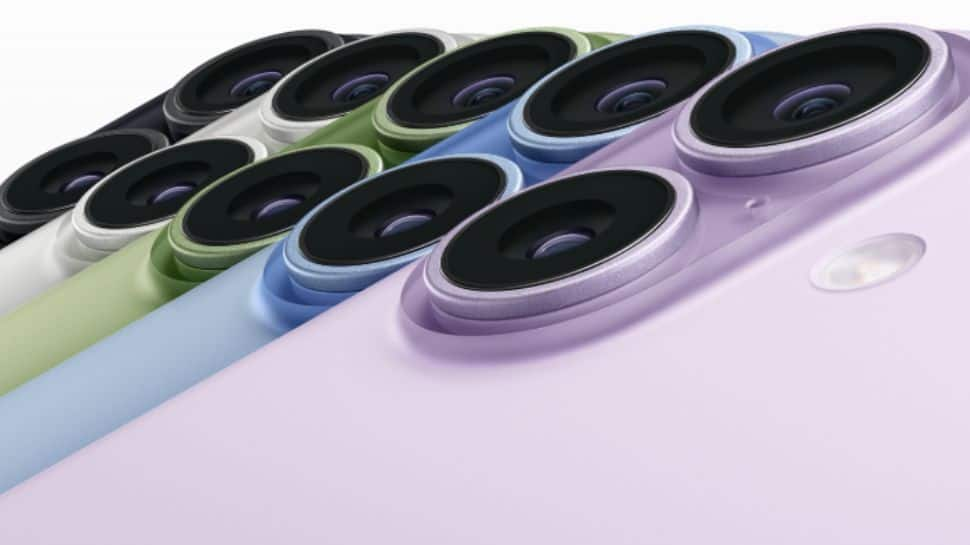
New Delhi: Riding on the stellar performance of the new iPhone 17 series, Apple is heading towards the $4 trillion market valuation, thus becoming the second-most valuable company after chip major Nvidia. Apple shares surged to an all-time high at $262.9 on Monday (US time). This took the company to a market valuation of nearly $3.9 trillion. Data from Counterpoint Research showed that the iPhone 17 series outperformed its predecessor in early sales globally, especially in key markets like China and the US. Apple will report its quarterly earnings on October 30. Meanwhile, in a boost to the ‘Make in India’ initiative, the iPhone 17 models are gaining stronger traction than last year’s iPhone 16 series in India, according to vendors and industry analysts. Tech giant achieved its highest festive-sales count in India, with analysts forecasting a 28 per cent year-on-year sales increase in 2025 owing to the success of the iPhone 17 series. Add Zee News as a Preferred Source Apple Annual Sales Apple saw its annual sales hit a record of nearly $9 billion last fiscal, as disposable incomes rise amid strong consumer demand. Analysts said that the first week of sales for the iPhone 17 series was 19 per cent higher than the iPhone 16 series. Apple was on track to cross 4.5 million shipments this festive quarter with the new iPhone Air poised to generate fresh traction. In a market dominated majorly by value for money phones, there is a good healthy growth for premium smartphones driven by rising disposable incomes among a growing middle class, according to analysts. iPhone 17 Model Price While iPhone 17 (256 GB) starts at Rs 82,900, iPhone Air (256 GB) begins from Rs 119,900; iPhone 17 Pro (256 GB) starts from Rs 134,900 and iPhone 17 Pro Max (256 GB) from Rs 149,900. India is also becoming central to Apple’s manufacturing plans, with one in every five iPhones now being produced in the country.
iQOO 15 Launched With World’s First 2K LEAD OLED Display Technology; Check Display, Camera, Battery, Price And Other Features | Technology News
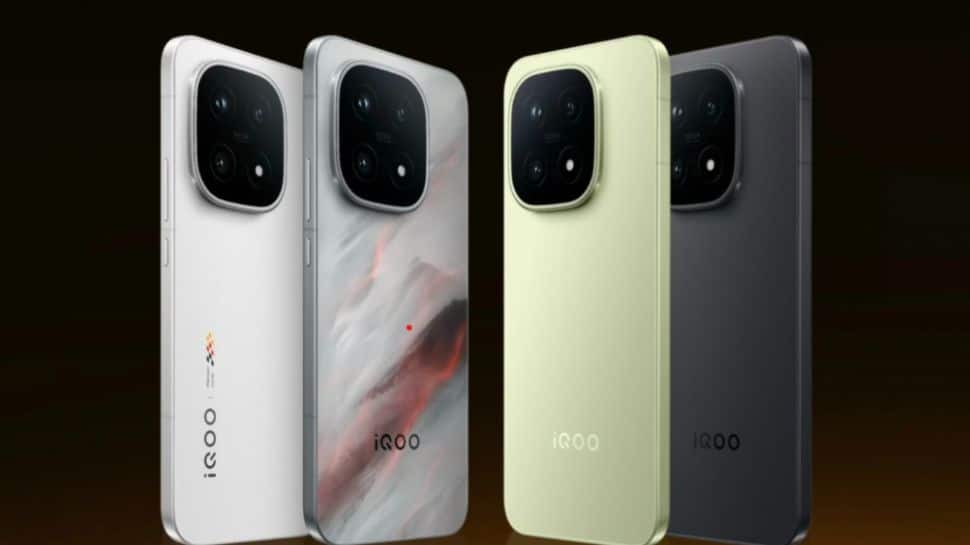
iQOO 15 Launch And Price: iQOO has launched its flagship iQOO 15 smartphone in China. The latest device comes with a powerful Snapdragon processor, several upgrades over the iQOO 13, and subtle design refinements. The company has also confirmed that the iQOO 15 will launch in India next month. Notably, the phone will run on OriginOS 6, replacing the long-standing Funtouch OS found in global variants of iQOO smartphones. The iQOO 15 debuts the world’s first 2K LEAD OLED display technology, which promises lower power consumption, higher brightness, enhanced eco-friendliness, and a slimmer profile. Adding further, it introduces the world’s first Pleasing Eye Protection 2.0, offering a non-polarized natural light display and hardware-level eye protection for gaming. The phone is offered in four colour options: iQOO 15 Lingyun, Legendary Edition, Track Edition, and Wilderness. Add Zee News as a Preferred Source iQOO 15 Specifications The phone features a stunning 6.85-inch 2K+ curved Samsung M14 8T LTPO AMOLED display with HDR10+ certification and a 144Hz refresh rate, delivering an ultra-smooth and vibrant viewing experience. It is powered by the latest Qualcomm Snapdragon 8 Elite Gen 5 processor paired with the Adreno 840 GPU, ensuring top-tier performance. The phone supports 12GB or 16GB of LPDDR5x RAM and 256GB, 512GB, or 1TB of UFS 4.1 storage, offering both speed and ample space for users. The smartphone houses a 7,000mAh battery with 100W wired fast charging (down from 120W on its predecessor) and 40W wireless charging support. (Also Read: Apple Eyes $4 Trillion Market Valuation Amid Robust iPhone 17 Series Sales) On the photography front, the iQOO 15 sports a triple rear camera setup comprising a 50MP primary sensor with OIS, a 50MP ultra-wide-angle lens, and a 50MP 3x periscope telephoto lens with OIS, while the front houses a 32MP camera for selfies and video calls. Adding further, it comes with an IP68/IP69 water and dust resistance rating, allowing it to withstand submersion up to 1.5 meters and resist cold or hot water jets from any direction. iQOO 15 Price The iQOO 15 starts at 4,199 yuan (Rs 51,900) for the 12GB RAM + 256GB storage model. The 16GB RAM + 512GB version is priced at 4,499 yuan (Rs 55,500), while the 12GB RAM + 512GB variant costs 4,699 yuan (Rs 58,000). The 16GB RAM + 512GB option is available for 4,999 yuan (Rs 61,700), and the top-end 16GB RAM + 1TB storage model is priced at 4,399 yuan (Rs 54,300).
Revolutionizing MLOps: Enhanced BigQuery ML UI for Seamless Model Creation and Management
Revolutionizing MLOps: Enhanced BigQuery ML UI for Seamless Model Creation and Management – MachineLearningMastery.com Revolutionizing MLOps: Enhanced BigQuery ML UI for Seamless Model Creation and Management – MachineLearningMastery.com

Amazon Web Services Faces Major Outage: ChatGPT, Alexa, Snapchat, And Online Game Among Affected Services | Technology News
Amazon Web Services Services Down: Amazon Web Services (AWS) faced a major outage on Monday, disrupting several online services worldwide, including AI tools, e-commerce platforms, popular websites, and online games. The outage affected access to Amazon’s virtual assistant Alexa, the social media app Snapchat, the online game Fortnite, the AI platform ChatGPT, as well as the Epic Games Store and Epic Online Services. Amazon Web Services, Inc., a subsidiary of Amazon, provides on-demand cloud computing platforms and APIs to individuals, businesses, and governments on a metered, pay-as-you-go basis. Amazon reported that it is “investigating increased error rates and latencies for multiple AWS services in the US-EAST-1 Region” and that multiple services are “impacted” by operational issues. Users on social media platform Reddit reported that the Alexa smart assistant is down and unable to respond to queries or complete requests. AWS’ cloud-hosted platforms such as Perplexity, Airtable, Canva, and the McDonald’s app were also affected, according to user reports. Add Zee News as a Preferred Source The cause of the outage hasn’t been confirmed, and it’s unclear when regular service will be restored. Perplexity CEO Aravind Srinivas informed on social media platform X, “Perplexity is down right now. The root cause is an AWS issue. We’re working on resolving it.” AWS outage knocks Amazon, ChatGPT, Alexa and dozens of apps offline. The AWS dashboard first reported issues affecting the US-EAST-1 Region at 3:11AM Eastern Time (ET). “We are actively engaged and working to both mitigate the issue and understand root cause. We will provide an update in 45 minutes, or sooner if we have additional information to share,” Amazon said. Later at 5:27 a.m. ET, Amazon reported “significant signs of recovery,” adding that “most requests should now be succeeding.” We continue to work through a backlog of queued requests, it said. AWS outages in the US-EAST-1 region had caused wide-spread disruptions in 2020, 2021, and 2023, leading to extended downtime for various sites and applications. (With IANS Inputs)
India Ranks Second Globally In Refurbished Smartphone Growth: Report | Technology News
New Delhi: India saw a 5 per cent year-on-year (YoY) increase in refurbished smartphone sales in H1CY25, marking the second-fastest growth globally, a report has said. Apple’s iPhones drove growth, with refurbished iPhone sales in India increasing by 19 per cent, fuelled by strong demand for premium models like the iPhone 13 and iPhone 14 series, according to the report from global market research firm Counterpoint Research. The report indicated that the ongoing premiumisation of the broader smartphone market is now extending to refurbished devices as well, supported by rising consumer awareness, stronger supply chains, and surging demand for high-end models. Africa led global growth with a 6 per cent increase, driven by strong iPhone demand, the report noted. Apple secured the second position in India’s refurbished market, as Samsung maintained the top spot, though experiencing a minor 1 per cent decline. Samsung’s lead was maintained by consistent demand for its Galaxy S22 and S23 models. Additionally, the Samsung Galaxy S22 and S21 were among the top-selling models in India, the report said. Add Zee News as a Preferred Source Southeast Asia’s pre-owned smartphone market also grew 5 per cent YoY in H1 2025, fueled by its large unorganised channels and steady inflow of used devices and components from China. Online platforms are driving the consumer-to-consumer (C2C) market, especially for refurbished smartphones. This growth is fuelled by increasing consumer trust, better supply chains, and the convenience of initiating negotiations and transactions digitally, the research firm said. Organised retailers in India are solidifying buyback initiatives in both online and offline markets by promoting flagship models as reliable and value-driven alternatives. Retailer-driven exchange programs, extended warranty offerings are also driving demand for newer refurbished devices. Apple’s iPhone exports totalled approximately $10 billion, accounting for over 75 per cent of shipments in the first half of the year.
WhatsApp Brings AI Image Generation For Status Updates For iOS And Android: How To Create And Share AI-Made Visuals | Technology News
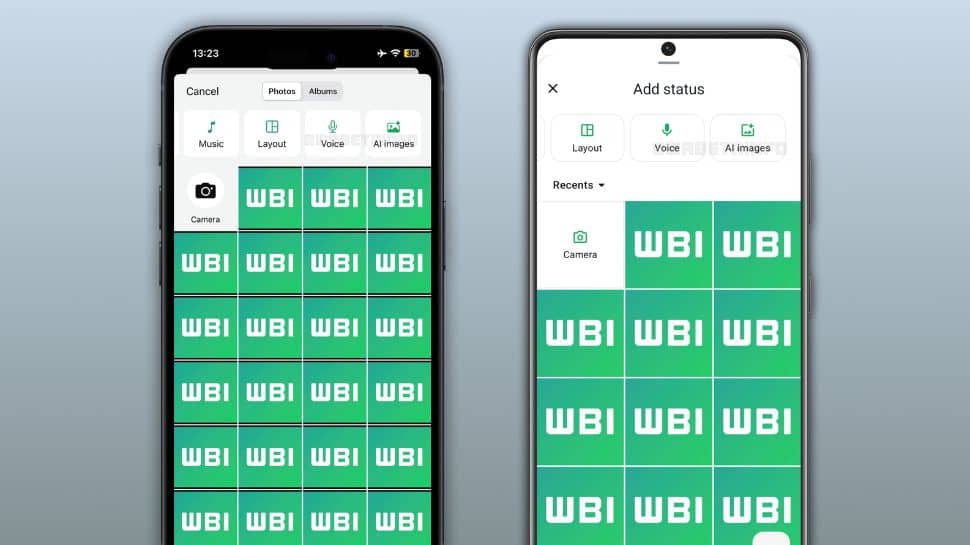
WhatsApp New AI-Powered Tool: Meta-owned WhatsApp is introducing a new AI image generation feature for status updates, allowing select users to create and share custom AI-generated visuals, as per WABetaInfo report. The new feature is powered by Meta’s advanced generative technology. It transforms simple text prompts into creative, shareable images directly within the app. However, the latest WhatsApp versions for Android and iOS are confirmed to support this feature. The new feature is currently accessible to select users, with a broader rollout expected in the coming weeks. WhatsApp Launches New AI-Powered Tool to Generate Status Images on iOS and Android! WhatsApp is rolling out a new feature that lets select users create and share custom AI-generated visuals as their status updates.https://t.co/ADJEkck9im pic.twitter.com/WwRICxya7v — WABetaInfo (@WABetaInfo) October 19, 2025 How To Create And Share AI-Made Visuals Add Zee News as a Preferred Source Step 1: Open WhatsApp and go to the Updates tab to create a new status. Step 2: Select the “AI Images” option from the status creation screen. Step 3: Type a prompt describing what you want the image to show, such as “a dreamy sunset over the sea” or “cyberpunk city at dusk.” Step 4: Meta AI will generate multiple image variations based on your prompt. Step 5: Scroll through the options and choose your favorite one — or refresh/edit the prompt to see new results. Step 6: Customize the selected image with captions, stickers, text, cropping, rotation, or drawings. Step 7: Once satisfied, tap “Send” to share your AI-generated image as a WhatsApp status update — all within the app’s built-in editor. Moreover, WhatsApp is working on a new Username Reservation feature that will allow users to secure their desired usernames before the feature officially launches. This addition aims to simplify the process of claiming unique usernames in advance, ensuring users can reserve their preferred identities ahead of the public rollout. (Also Read: Happy Diwali 2025: How To Download Stickers On WhatsApp? Try These 10 AI Prompts To Wish Your Friends And Family With Customize Short Video) Adding further, WhatsApp is testing a new anti-spam tool designed to curb unwanted messages from businesses and unknown contacts. The Meta-owned messaging platform, with over 2 billion global users, is reportedly experimenting with monthly limits on outbound messages to non-contacts who don’t respond. The move is intended to significantly reduce promotional spam and enhance the overall user experience.

‘Nano Banana’ Trend: 25 Must-Try Prompts For Diwali 2025 On Google Gemini App | Technology News
Google’s Gemini Nano Banana—powered by the Gemini 2.5 Flash Image model—is lighting up the internet this festive season. The trend lets users turn their selfies, couple portraits, and family photos into breathtaking Diwali posters brimming with light, color, and cinematic flair. Whether you want dazzling diyas or Bollywood-style charm, using the right prompts can make your image look straight out of a designer ad poster. Here are 25 creative Gemini Nano Banana prompts to try and make your Diwali 2025 photos shine brighter than sparklers. Glamorous Portrait Prompts Add Zee News as a Preferred Source “Create a Diwali portrait of me wearing a royal lehenga with gold embroidery, holding a diya under golden fairy lights, with cinematic bokeh lights in the background.” “A Bollywood-inspired couple photo in crimson and ivory attire, standing before a diya-lit temple with subtle fireworks in the sky.” “Make an elegant portrait in Manish Malhotra-style fashion, a glowing diya in hand, with the text ‘Happy Diwali 2025’ in stylish cursive typography.” “Generate a close-up festive selfie surrounded by floating diyas and marigold petals, soft golden lighting, and minimal sparkle effects.” “Create a dramatic 90s Bollywood frame—posing beside a vintage lamp post in ethnic wear with neon ‘Diwali Lights’ in the background.” Family and Friends Prompts “A cozy family photo inside a living room decorated with fairy lights, candles, and rangoli, everyone smiling and dressed in colorful ethnic outfits.” “Friends lighting diyas together on a balcony with a city skyline sparkling below, candid laughter captured naturally.” “Group photo of siblings decorating a rangoli made of marigolds and diyas with vibrant energy.” “Children playing with sparklers under the night sky while parents look on, warm festive tones all around.” “A grand family dining scene with traditional silverware, glowing candles, and festive sweets arranged beautifully.” Decor and Artistic Prompts “A top-view of an intricate rangoli design in peacock colors surrounded by diyas casting warm shadows.” “Generate an image of a balcony decorated with lanterns, torans, and fairy lights glowing in deep golden tones.” “A modern Diwali setup featuring minimalist décor, candles, and floral petals under warm white light.” “A temple courtyard surrounded by diyas forming beautiful geometric patterns, with twilight colors in the background.” “Craft an image of glowing clay lamps placed on stairs, each lamp casting a soft reflection on polished tiles.” Creative and Quirky Prompts “An animated-style portrait of a couple lighting diyas in a dreamy watercolor theme.” “A futuristic Diwali evening in a smart home glowing with neon lamps and interactive LED rangoli.” “A cinematic Diwali street with vendors selling diyas, sweets, and garlands under festive lights.” “A vintage-style festive photo that looks shot on film, with soft focus and warm tones.” “Turn me into a traditional goddess-inspired Diwali portrait, adorned with rich jewelry and golden lighting.” Social Media Poster Prompts “A festive greeting poster featuring my portrait with ‘Happy Diwali 2025’ written in elegant Devanagari typography.” “A minimalist Diwali wallpaper with floating diyas and pastel background, perfect for Instagram Stories.” “Generate a cinematic Diwali greeting card with text overlay ‘Light up your world this Diwali’ in golden cursive font.” “A sparkling poster style portrait with bokeh background and text: ‘Brighter vibes, better year ahead.’” “Create a traditional Diwali greeting: me lighting diyas beside rangoli, with text in bold gold letters: ‘Shubh Deepavali 2025.’” How to Use These Prompts To try these, open the Google app or Gemini AI Studio, switch to AI Mode or Gemini Nano, and simply type your chosen prompt. Upload a selfie or reference photo, hit Generate, and watch your Diwali vision come to life instantly.