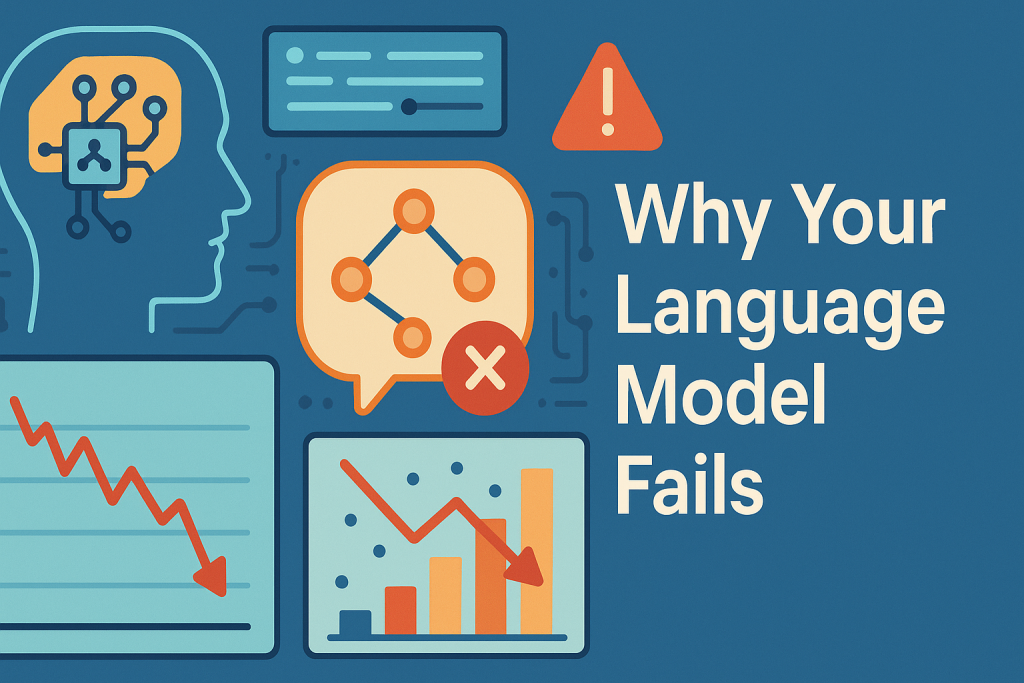
In this article, you will learn a clear, practical framework to diagnose why a language model underperforms and how to validate likely causes quickly. Topics we will cover include: Five common failure modes and what they look like Concrete diagnostics you can run immediately Pragmatic mitigation tips for each failure Let’s not waste any more time. How to Diagnose Why Your Language Model FailsImage by Editor Introduction Language models, as incredibly useful as they are, are not perfect, and they may fail or exhibit undesired performance due to a variety of factors, such as data quality, tokenization constraints, or difficulties in correctly interpreting user prompts. This article adopts a diagnostic standpoint and explores a 5-point framework for understanding why a language model — be it a large, general-purpose large language model (LLM), or a small, domain-specific one — might fail to perform well. Diagnostic Points for a Language Model In the following sections, we will uncover common reasons for failure in language models, briefly describing each one and providing practical tips for diagnosis and how to overcome them. 1. Poor Quality or Insufficient Training Data Just like other machine learning models such as classifiers and regressors, a language model’s performance greatly depends on the amount and quality of the data used to train it, with one not-so-subtle nuance: language models are trained on very large datasets or text corpora, often spanning from many thousands to millions or billions of documents. When the language model generates outputs that are incoherent, factually incorrect, or nonsensical (hallucinations) even for simple prompts, chances are the quality or amount of training data used is not sufficient. Specific causes could include a training corpus that is too small, outdated, or full of noisy, biased, or irrelevant text. In smaller language models, the consequences of this data-related issue also include missing domain vocabulary in generated answers. To diagnose data issues, inspect a sufficiently representative portion of the training data if possible, analyzing properties such as relevance, coverage, and topic balance. Running targeted prompts about known facts and using rare terms to identify knowledge gaps is also an effective diagnostic strategy. Finally, keep a trusted reference dataset handy to compare generated outputs with information contained there. When the language model generates outputs that are incoherent, factually incorrect, or nonsensical (hallucinations) even for simple prompts, chances are the quality or amount of training data used is not sufficient. 2. Tokenization or Vocabulary Limitations Suppose that by analyzing the inner behavior of a freshly trained language model, it appears to struggle with certain words or symbols in the vocabulary, breaking them into tokens in an unexpected manner, or failing to properly represent them. This may stem from the tokenizer used in conjunction with the model, which does not align appropriately with the target domain, yielding far-from-ideal treatment of uncommon words, technical jargon, and so on. Diagnosing tokenization and vocabulary issues involves inspecting the tokenizer, namely by checking how it splits domain-specific terms. Utilizing metrics such as perplexity or log-likelihood on a held-out subset can quantify how well the model represents domain text, and testing edge cases — e.g., non-Latin scripts or words and symbols containing uncommon Unicode characters — helps pinpoint root causes related to token management. 3. Prompt Instability and Sensitivity A small change in the wording of a prompt, its punctuation, or the order of multiple nonsequential instructions can lead to significant changes in the quality, accuracy, or relevance of the generated output. That is prompt instability and sensitivity: the language model becomes overly sensitive to how the prompt is articulated, often because it has not been properly fine-tuned for effective, fine-grained instruction following, or because there are inconsistencies in the training data. The best way to diagnose prompt instability is experimentation: try a battery of paraphrased prompts whose overall meaning is equivalent, and compare how consistent the results are with each other. Likewise, try to identify patterns under which a prompt results in a stable versus an unstable response. 4. Context Windows and Memory Constraints When a language model fails to use context introduced in earlier interactions as part of a conversation with the user, or misses earlier context in a long document, it can start exhibiting undesired behavior patterns such as repeating itself or contradicting content it “said” before. The amount of context a language model can retain, or context window, is largely determined by memory limitations. Accordingly, context windows that are too short may truncate relevant information and drop earlier cues, whereas overly lengthy contexts can hinder tracking of long-range dependencies. Diagnosing issues related to context windows and memory limitations entails iteratively evaluating the language model with increasingly longer inputs, carefully measuring how much it can correctly recall from earlier parts. When available, attention visualizations are a powerful resource to check whether relevant tokens are attended across long ranges in the text. 5. Domain and Temporal Drifts Once deployed, a language model is still not exempt from providing wrong answers — for example, answers that are outdated, that miss recently coined terms or concepts, or that fail to reflect evolving domain knowledge. This means the training data might have become anchored in the past, still relying on a snapshot of the world that has already changed; consequently, changes in facts inevitably lead to knowledge degradation and performance degradation. This is analogous to data and concept drifts in other types of machine learning systems. To diagnose temporal or domain-related drifts, continuously compile benchmarks of new events, terms, articles, and other relevant materials in the target domain. Track the accuracy of responses using these new language items compared to responses related to stable or timeless knowledge, and see if there are significant differences. Additionally, schedule periodic performance-monitoring schemes based on “fresh queries.” Final Thoughts This article examined several common reasons why language models may fail to perform well, from data quality issues to poor management of context and drifts in production caused by changes in factual knowledge. Language models are inevitably complex; therefore, understanding possible reasons

Essential Chunking Techniques for Building Better LLM Applications
Essential Chunking Techniques for Building Better LLM ApplicationsImage by Author Introduction Every large language model (LLM) application that retrieves information faces a simple problem: how do you break down a 50-page document into pieces that a model can actually use? So when you’re building a retrieval-augmented generation (RAG) app, before your vector database retrieves anything and your LLM generates responses, your documents need to be split into chunks. The way you split documents into chunks determines what information your system can retrieve and how accurately it can answer queries. This preprocessing step, often treated as a minor implementation detail, actually determines whether your RAG system succeeds or fails. The reason is simple: retrieval operates at the chunk level, not the document level. Proper chunking improves retrieval accuracy, reduces hallucinations, and ensures the LLM receives focused, relevant context. Poor chunking cascades through your entire system, causing failures that retrieval mechanisms can’t fix. This article covers essential chunking strategies and explains when to use each method. Why Chunking Matters Embedding models and LLMs have finite context windows. Documents typically exceed these limits. Chunking solves this by breaking long documents into smaller segments, but introduces an important trade-off: chunks must be small enough for efficient retrieval while remaining large enough to preserve semantic coherence. Vector search operates on chunk-level embeddings. When chunks mix multiple topics, their embeddings represent an average of those concepts, making precise retrieval difficult. When chunks are too small, they lack sufficient context for the LLM to generate useful responses. The challenge is finding the middle ground where chunks are semantically focused yet contextually complete. Now let’s get to the actual chunking techniques you can experiment with. 1. Fixed-Size Chunking Fixed-size chunking splits text based on a predetermined number of tokens or characters. The implementation is straightforward: Select a chunk size (commonly 512 or 1024 tokens) Add overlap (typically 10–20%) Divide the document The method ignores document structure entirely. Text splits at arbitrary points regardless of semantic boundaries, often mid-sentence or mid-paragraph. Overlap helps preserve context at boundaries but doesn’t address the core issue of structure-blind splitting. Despite its limitations, fixed-size chunking provides a solid baseline. It’s fast, deterministic, and works adequately for documents without strong structural elements. When to use: Baseline implementations, simple documents, rapid prototyping. 2. Recursive Chunking Recursive chunking improves on fixed-size approaches by respecting natural text boundaries. It attempts to split at progressively finer separators — first at paragraph breaks, then sentences, then words — until chunks fit within the target size. Recursive ChunkingImage by Author The algorithm tries to keep semantically related content together. If splitting at paragraph boundaries produces chunks within the size limit, it stops there. If paragraphs are too large, it recursively applies sentence-level splitting to oversized chunks only. This maintains more of the document’s original structure than arbitrary character splitting. Chunks tend to align with natural thought boundaries, improving both retrieval relevance and generation quality. When to use: General-purpose applications, unstructured text like articles and reports. 3. Semantic Chunking Rather than relying on characters or structure, semantic chunking uses meaning to determine boundaries. The process embeds individual sentences, compares their semantic similarity, and identifies points where topic shifts occur. Semantic ChunkingImage by Author Implementation involves computing embeddings for each sentence, measuring distances between consecutive sentence embeddings, and splitting where distance exceeds a threshold. This creates chunks where content coheres around a single topic or concept. The computational cost is higher. But the result is semantically coherent chunks that often improve retrieval quality for complex documents. When to use: Dense academic papers, technical documentation where topics shift unpredictably. 4. Document-Based Chunking Documents with explicit structure — Markdown headers, HTML tags, code function definitions — contain natural splitting points. Document-based chunking leverages these structural elements. For Markdown, split on header levels. For HTML, split on semantic tags like <section> or <article>. For code, split on function or class boundaries. The resulting chunks align with the document’s logical organization, which typically correlates with semantic organization. Here’s an example of document-based chunking: Document-Based ChunkingImage by Author Libraries like LangChain and LlamaIndex provide specialized splitters for various formats, handling the parsing complexity while letting you focus on chunk size parameters. When to use: Structured documents with clear hierarchical elements. 5. Late Chunking Late chunking reverses the typical embedding-then-chunking sequence. First, embed the entire document using a long-context model. Then split the document and derive chunk embeddings by averaging the relevant token-level embeddings from the full document embedding. This preserves global context. Each chunk’s embedding reflects not just its own content but its relationship to the broader document. References to earlier concepts, shared terminology, and document-wide themes remain encoded in the embeddings. The approach requires long-context embedding models capable of processing entire documents, limiting its applicability to reasonably sized documents. When to use: Technical documents with significant cross-references, legal texts with internal dependencies. 6. Adaptive Chunking Adaptive chunking dynamically adjusts chunk parameters based on content characteristics. Dense, information-rich sections receive smaller chunks to maintain granularity. Sparse, contextual sections receive larger chunks to preserve coherence. Adaptive ChunkingImage by Author The implementation typically uses heuristics or lightweight models to assess content density and adjust chunk size accordingly. When to use: Documents with highly variable information density. 7. Hierarchical Chunking Hierarchical chunking creates multiple granularity levels. Large parent chunks capture broad themes, while smaller child chunks contain specific details. At query time, retrieve coarse chunks first, then drill into fine-grained chunks within relevant parents. This enables both high-level queries (“What does this document cover?”) and specific queries (“What’s the exact configuration syntax?”) using the same chunked corpus. Implementation requires maintaining relationships between chunk levels and traversing them during retrieval. When to use: Large technical manuals, textbooks, comprehensive documentation. 8. LLM-Based Chunking In LLM-based chunking, we use an LLM to determine chunk boundaries and push chunking into intelligent territory. Instead of rules or embeddings, the LLM analyzes the document and decides how to split it based on semantic understanding. LLM-Based ChunkingImage by Author Approaches include breaking text into atomic

Free AI and Data Courses with 365 Data Science—100% Unlimited Access until Nov 21
Sponsored Content Free AI and Data Courses with 365 Data Science—100% Unlimited Access until Nov 21 From November 6 to November 21, 2025 (starting at 8:00 a.m. UTC), 365 Data Science will grant free access to its entire learning platform. This limited-time opportunity allows aspiring AI professionals and data enthusiasts to enhance their skills and gain practical, hands-on experience—completely free of charge. Tradition and Mission Now in its fifth year, 365 Data Science reaffirms its dedication to providing accessible, high-quality education through its annual Free Access Initiative, first introduced during the global pandemic in 2020. CEO Ned Krastev emphasizes the growing importance of AI-related skills, stating that “the AI and data landscape is evolving faster than ever, creating extraordinary opportunities for those ready to embrace new technologies.” The initiative’s impact has grown dramatically—2024 marked its most successful edition yet, attracting over 200,000 unique users from 215 countries, who collectively logged 6.9 million minutes of learning and earned more than 35,000 certificates. Krastev adds, “Artificial intelligence is reshaping industries at an unprecedented pace. Gaining an understanding of how AI systems are built, deployed, and integrated has become essential for anyone pursuing a data-driven career. At 365 Data Science, our goal is to close that gap by helping learners develop both data literacy and hands-on expertise in AI engineering and intelligent agents—the defining skills of tomorrow’s tech professionals.” Free AI and Data Courses with 365 Data Science—100% Unlimited Access until Nov 21 365 Data Science empowers learners to go beyond traditional data analytics and step into the era of AI engineering and intelligent agents—equipping them with the expertise to design, deploy, and work alongside AI systems capable of reasoning, planning, and acting autonomously. What’s Included? During this limited-time period, learners will gain unrestricted access to the entire 365 Data Science platform—a comprehensive destination for mastering data and AI. The platform offers over 117 expert-led courses, covering everything from foundational data skills to advanced topics in AI, machine learning, and AI engineering. Participants can gain practical experience through real AI and data projects that mirror actual work scenarios, allowing them to apply their knowledge effectively. Newly introduced interactive exercises and guided challenges strengthen understanding and reinforce key concepts. Moreover, 365 Data Science provides structured, career-focused learning paths that lead users step by step—from beginner to job-ready professional—offering a clear roadmap to success in today’s AI-driven world. Certifications that Open Doors In today’s fast-changing job market, recognized certifications are essential for standing out. Through this Free Access Initiative, 365 Data Science enables learners to earn industry-recognized certificates completely free of charge. These credentials demonstrate practical expertise in data analytics, AI, and machine learning, boosting participants’ employability and credibility with employers across the globe. The initiative bridges the gap between education and career advancement by offering verifiable, career-enhancing certifications that highlight real-world competence. Don’t Miss this Opportunity In a world increasingly driven by data and artificial intelligence, staying ahead of the curve is more important than ever. This three-week open-access period from 365 Data Science offers a unique opportunity to invest in your future—whether you’re beginning your journey, changing careers, or advancing your skills in AI and data. Don’t miss your chance to gain in-demand expertise, earn industry-recognized certificates, and take the next step toward a rewarding career in data science and AI engineering. The future belongs to those who prepare for it today—start your journey for free with 365 Data Science.
Everything You Need to Know About LLM Evaluation Metrics
In this article, you will learn how to evaluate large language models using practical metrics, reliable benchmarks, and repeatable workflows that balance quality, safety, and cost. Topics we will cover include: Text quality and similarity metrics you can automate for quick checks. When to use benchmarks, human review, LLM-as-a-judge, and verifiers. Safety/bias testing and process-level (reasoning) evaluations. Let’s get right to it. Everything You Need to Know About LLM Evaluation MetricsImage by Author Introduction When large language models first came out, most of us were just thinking about what they could do, what problems they could solve, and how far they might go. But lately, the space has been flooded with tons of open-source and closed-source models, and now the real question is: how do we know which ones are actually any good? Evaluating large language models has quietly become one of the trickiest (and surprisingly complex) problems in artificial intelligence. We really need to measure their performance to make sure they actually do what we want, and to see how accurate, factual, efficient, and safe a model really is. These metrics are also super useful for developers to analyze their model’s performance, compare with others, and spot any biases, errors, or other problems. Plus, they give a better sense of which techniques are working and which ones aren’t. In this article, I’ll go through the main ways to evaluate large language models, the metrics that actually matter, and the tools that help researchers and developers run evaluations that mean something. Text Quality and Similarity Metrics Evaluating large language models often means measuring how closely the generated text matches human expectations. For tasks like translation, summarization, or paraphrasing, text quality and similarity metrics are used a lot because they provide a quantitative way to check output without always needing humans to judge it. For example: BLEU compares overlapping n-grams between model output and reference text. It is widely used for translation tasks. ROUGE-L focuses on the longest common subsequence, capturing overall content overlap—especially useful for summarization. METEOR improves on word-level matching by considering synonyms and stemming, making it more semantically aware. BERTScore uses contextual embeddings to compute cosine similarity between generated and reference sentences, which helps in detecting paraphrases and semantic similarity. For classification or factual question-answering tasks, token-level metrics like Precision, Recall, and F1 are used to show correctness and coverage. Perplexity (PPL) measures how “surprised” a model is by a sequence of tokens, which works as a proxy for fluency and coherence. Lower perplexity usually means the text is more natural. Most of these metrics can be computed automatically using Python libraries like nltk, evaluate, or sacrebleu. Automated Benchmarks One of the easiest ways to check large language models is by using automated benchmarks. These are usually big, carefully designed datasets with questions and expected answers, letting us measure performance quantitatively. Some popular ones are MMLU (Massive Multitask Language Understanding), which covers 57 subjects from science to humanities, GSM8K, which is focused on reasoning-heavy math problems, and other datasets like ARC, TruthfulQA, and HellaSwag, which test domain-specific reasoning, factuality, and commonsense knowledge. Models are often evaluated using accuracy, which is basically the number of correct answers divided by total questions: Accuracy = Correct Answers / Total Questions Accuracy = Correct Answers / Total Questions For a more detailed look, log-likelihood scoring can also be used. It measures how confident a model is about the correct answers. Automated benchmarks are great because they’re objective, reproducible, and good for comparing multiple models, especially on multiple-choice or structured tasks. But they’ve got their downsides too. Models can memorize the benchmark questions, which can make scores look better than they really are. They also often don’t capture generalization or deep reasoning, and they aren’t very useful for open-ended outputs. You can also use some automated tools and platforms for this. Human-in-the-Loop Evaluation For open-ended tasks like summarization, story writing, or chatbots, automated metrics often miss the finer details of meaning, tone, and relevance. That’s where human-in-the-loop evaluation comes in. It involves having annotators or real users read model outputs and rate them based on specific criteria like helpfulness, clarity, accuracy, and completeness. Some systems go further: for example, Chatbot Arena (LMSYS) lets users interact with two anonymous models and choose which one they prefer. These choices are then used to calculate an Elo-style score, similar to how chess players are ranked, giving a sense of which models are preferred overall. The main advantage of human-in-the-loop evaluation is that it shows what real users prefer and works well for creative or subjective tasks. The downsides are that it is more expensive, slower, and can be subjective, so results may vary and require clear rubrics and proper training for annotators. It is useful for evaluating any large language model designed for user interaction because it directly measures what people find helpful or effective. LLM-as-a-Judge Evaluation A newer way to evaluate language models is to have one large language model judge another. Instead of depending on human reviewers, a high-quality model like GPT-4, Claude 3.5, or Qwen can be prompted to score outputs automatically. For example, you could give it a question, the output from another large language model, and the reference answer, and ask it to rate the output on a scale from 1 to 10 for correctness, clarity, and factual accuracy. This method makes it possible to run large-scale evaluations quickly and at low cost, while still getting consistent scores based on a rubric. It works well for leaderboards, A/B testing, or comparing multiple models. But it’s not perfect. The judging large language model can have biases, sometimes favoring outputs that are similar to its own style. It can also lack transparency, making it hard to tell why it gave a certain score, and it might struggle with very technical or domain-specific tasks. Popular tools for doing this include OpenAI Evals, Evalchemy, and Ollama for local comparisons. These let teams automate a lot of the evaluation without needing humans for every test.

Oppo Reno 15 Series Set To Launch In China On Nov 17: Expected Models, Specs, Features | Technology News
Oppo Reno 15 Series: Oppo has officially announced the launch date of its upcoming Reno 15 smartphone series in China. The lineup, which will include the Reno 15, Reno 15 Pro, and a new Reno 15 Mini, is set to debut on November 17 at 7pm local time (4:30pm IST). The launch will coincide with the brand’s Double Eleven (11.11) shopping festival celebrations in the country. Three Models in Lineup The Reno 15 series will include three models — the standard Reno 15, the Reno 15 Pro, and the smaller Reno 15 Mini. Oppo has already listed the Reno 15 and Reno 15 Pro on its official e-shop, and pre-orders are currently open ahead of the launch event. Add Zee News as a Preferred Source Colour Options and Storage Variants According to the official listing, the Oppo Reno 15 will come in three colour options — Starlight Bow, Aurora Blue, and Canele Brown. It will be available in five RAM and storage options: 12GB + 256GB 12GB + 512GB 16GB + 256GB 16GB + 512GB 16GB + 1TB The Oppo Reno 15 Pro, on the other hand, will be offered in Starlight Bow, Canele Brown, and Honey Gold colour options. This model will have four RAM and storage options: 12GB + 256GB 12GB + 512GB 16GB + 512GB 16GB + 1TB (Also Read: GTA 6 Delayed Again — Fans Disappointed As Launch Pushed To November 2026) Expected Display Sizes According to reports, the Reno 15 Pro will feature a 6.78-inch 1.5K flat display, while the compact Reno 15 Mini could come with a 6.32-inch 1.5K screen. The standard Reno 15 is expected to sit between the two, with a 6.59-inch display. Camera Specifications The Reno 15 Pro and Reno 15 Mini are rumoured to feature triple rear camera setups. Both models may include a 200-megapixel Samsung ISOCELL HP5 primary sensor, a 50-megapixel ultrawide camera, and a 50-megapixel periscope lens. On the front, all models are expected to sport 50-megapixel selfie cameras for high-quality front photography. The Oppo Reno 15 series launch event will take place on November 17, and the devices are already listed for pre-order in China.
The 7 Statistical Concepts You Need to Succeed as a Machine Learning Engineer
The 7 Statistical Concepts You Need to Succeed as a Machine Learning EngineerImage by Editor Introduction When we ask ourselves the question, “what is inside machine learning systems?“, many of us picture frameworks and models that make predictions or perform tasks. Fewer of us reflect on what truly lies at their core: statistics — a toolbox of models, concepts, and methods that enable systems to learn from data and do their jobs reliably. Understanding key statistical ideas is vital for machine learning engineers and practitioners: to interpret the data used alongside machine learning systems, to validate assumptions about inputs and predictions, and ultimately to build trust in these models. Given statistics’ role as an invaluable compass for machine learning engineers, this article covers seven core pillars that every person in this role should know — not only to succeed in interviews, but to build reliable and robust machine learning systems in day-to-day work. 7 Key Statistical Concepts for Machine Learning Engineers Without further ado, here are the seven cornerstone statistical concepts that should become part of your core knowledge and skill set. 1. Probability Foundations Virtually every machine learning model — from simple classifiers based on logistic regression to state-of-the-art language models — has probabilistic foundations. Consequently, developing a solid understanding of random variables, conditional probability, Bayes’ theorem, independence, joint distributions, and related ideas is essential. Models that make intensive use of these concepts include Naive Bayes classifiers for tasks like spam detection, hidden Markov models for sequence prediction and speech recognition, and the probabilistic reasoning components of transformer models that estimate token likelihoods and generate coherent text. Bayes’ theorem shows up throughout machine learning workflows — from missing-data imputation to model calibration strategies — so it is a natural place to start your learning journey. 2. Descriptive and Inferential Statistics Descriptive statistics provides foundational measures to summarize properties of your data, including common metrics like mean and variance and other important ones for data-intensive work, such as skewness and kurtosis, which help characterize distribution shape. Meanwhile, inferential statistics encompasses methods for testing hypotheses and drawing conclusions about populations based on samples. The practical use of these two subdomains is ubiquitous across machine learning engineering: hypothesis testing, confidence intervals, p-values, and A/B testing are used to evaluate models and production systems and to interpret feature effects on predictions. That is a strong reason for machine learning engineers to understand them deeply. 3. Distributions and Sampling Different datasets exhibit different properties and distinct statistical patterns or shapes. Understanding and distinguishing among distributions — such as Normal, Bernoulli, Binomial, Poisson, Uniform, and Exponential — and identifying which one is appropriate for modeling or simulating your data are important for tasks like bootstrapping, cross-validation, and uncertainty estimation. Closely related concepts like the Central Limit Theorem (CLT) and the Law of Large Numbers are fundamental for assessing the reliability and convergence of model estimates. For an extra tip, gain a firm understanding of tails and skewness in distributions — doing so makes detecting issues, outliers, and data imbalance significantly easier and more effective. 4. Correlation, Covariance, and Feature Relationships These concepts reveal how variables move together — what tends to happen to one variable when another increases or decreases. In daily machine learning engineering, they inform feature selection, checks for multicollinearity, and dimensionality-reduction techniques like principal component analysis (PCA). Not all relationships are linear, so additional tools are necessary — for example, the Spearman rank coefficient for monotonic relationships and methods for identifying nonlinear dependencies. Proper machine learning practice starts with a clear understanding of which features in your dataset truly matter for your model. 5. Statistical Modeling and Estimation Statistical models approximate and represent aspects of reality by analyzing data. Concepts central to modeling and estimation — such as the bias–variance trade-off, maximum likelihood estimation (MLE), and ordinary least squares (OLS) — are crucial for training (fitting) models, tuning hyperparameters to optimize performance, and avoiding pitfalls like overfitting. Understanding these ideas illuminates how models are built and trained, revealing surprising similarities between simple models like linear regressors and complex ones like neural networks. 6. Experimental Design and Hypothesis Testing Closely related to inferential statistics but one step beyond, experimental design and hypothesis testing ensure that improvements arise from genuine signal rather than chance. Rigorous methods validate model performance, including control groups, p-values, false discovery rates, and power analysis. A very common example is A/B testing, widely used in recommender systems to compare a new recommendation algorithm against the production version and decide whether to roll it out. Think statistically from the start — before collecting data for tests and experiments, not after. 7. Resampling and Evaluation Statistics The final pillar includes resampling and evaluation approaches such as permutation tests and, again, cross-validation and bootstrapping. These techniques are used with model-specific metrics like accuracy, precision, and F1 score, and their outcomes should be interpreted as statistical estimates rather than fixed values. The key insight is that metrics have variance. Approaches like confidence intervals often provide better insight into model behavior than single-number scores. Conclusion When machine learning engineers have a deep understanding of the statistical concepts, methods, and ideas listed in this article, they do more than tune models: they can interpret results, diagnose issues, and explain behavior, predictions, and potential problems. These skills are a major step toward trustworthy AI systems. Consider reinforcing these concepts with small Python experiments and visual explorations to cement your intuition.

Families Sue OpenAI Over Alleged Suicides, Psychological Harm Linked To ChatGPT: Report | Technology News
ChatGPT maker OpenAI is facing several new lawsuits from families who say the company released its GPT-4o model too early. They claim the model may have contributed to suicides and mental health problems, according to reports. OpenAI, based in the US, launched GPT-4o in May 2024, making it the default model for all users. In August, it introduced GPT-5 as its next version. According to TechCrunch, the model reportedly had issues with being “too agreeable” or “overly supportive,” even when users expressed harmful thoughts. The report said that four lawsuits blame ChatGPT for its alleged role in family members’ suicides, while three others claim the chatbot encouraged harmful delusions that led some people to require psychiatric treatment. Add Zee News as a Preferred Source According to the report, the lawsuits also claim that OpenAI rushed safety testing to beat Google’s Gemini to market. OpenAI has yet to comment on the report. Recent legal filings allege that ChatGPT can encourage suicidal people to act on their plans and inspire dangerous delusions. “OpenAI recently released data stating that over one million people talk to ChatGPT about suicide weekly,” the report mentioned. (Also Read: ChatGPT Go Now Free In India For One Year: OpenAI Launches Special Offer Starting November 4- Check Details) In a recent blog post, OpenAI said it worked with more than 170 mental health experts to help ChatGPT more reliably recognize signs of distress, respond with care, and guide people toward real-world support—reducing responses that fall short of its desired behavior by 65–80 percent. “We believe ChatGPT can provide a supportive space for people to process what they’re feeling and guide them to reach out to friends, family, or a mental health professional when appropriate,” it noted. “Going forward, in addition to our longstanding baseline safety metrics for suicide and self-harm, we are adding emotional reliance and non-suicidal mental health emergencies to our standard set of baseline safety testing for future model releases,” OpenAI added. (With inputs of IANS).

How Much YouTube Pays For Per 1,000 Views? Revenue On YouTube Earning Calculator Will Leave You Shocked | Technology News
YouTube has grown into one of the world’s largest and most profitable platforms for digital creators, offering people the chance to turn their creativity into a full-time career. Every day, millions of videos are uploaded across categories like entertainment, technology, education, gaming, and lifestyle. With such massive reach, YouTube has become a key source of income for influencers, vloggers, and businesses. However, understanding how much YouTube pays for videos or views depends on various factors. Many new YouTubers often wonder how much the platform actually pays per 1,000 views, as earnings can vary widely. The amount depends on factors like video content type, viewer location, ad engagement, and the overall demand from advertisers within that niche. How YouTube Earnings Work Add Zee News as a Preferred Source YouTube pays creators through its YouTube Partner Program (YPP). To join the program, a channel must have at least 1,000 subscribers and 4,000 valid watch hours in the past 12 months. Once approved, creators can start earning money through ads that appear on their videos. The payment is calculated based on CPM (Cost Per Mille), which means the amount advertisers pay per 1,000 ad impressions. However, creators don’t receive the full CPM amount, YouTube keeps about 45% of the ad revenue, while the remaining 55% goes to the creator. (Also Read: GTA 6 Delayed Again — Fans Disappointed As Launch Pushed To November 2026) Average YouTube Pay per 1,000 Views The amount YouTube pays per 1,000 views varies widely depending on several factors such as country, content type, audience demographics, and engagement. On average, creators can earn between $0.50 and $5 per 1,000 views. Entertainment and Vlogs: $0.50 – $2 per 1,000 views Tech and Gadgets: $2 – $4 per 1,000 views Finance and Business: $5 – $10 per 1,000 views Education and Tutorials: $1 – $4 per 1,000 views Channels focusing on financial advice, business tips, or digital marketing earn more because advertisers in those categories pay higher rates. In contrast, general entertainment channels usually have lower ad rates due to broad audiences and less targeted ads. YouTube Earning Calculator A YouTube Earning Calculator is an online tool that helps estimate how much a creator might earn from their videos. Users simply enter the number of views, estimated CPM, and engagement rate to get an approximate earning figure. For example, if a channel gets 100,000 views with a CPM of $3, the total revenue would be around $300 before YouTube’s share. After YouTube takes its 45% cut, the creator would earn approximately $165. While this tool gives a helpful estimate, the actual amount can differ depending on ad availability, viewer location, and the percentage of viewers who watch ads instead of skipping them. (Also Read: GTA 6 Trailer Release: Ahead Of Much-Hyped Launch, YouTube Tightens Violent Game Rules – All You Need To Know) Other Ways Creators Earn on YouTube Apart from ad revenue, many creators earn money through: Channel memberships Super Chat and Super Stickers (during live streams) Brand sponsorships and collaborations Affiliate marketing Merchandise sales YouTube does not pay a fixed amount for per 1,000 views. The earnings depend on the content category, viewer engagement, and location. Using a YouTube Earning Calculator can help estimate potential income, but real earnings vary from channel to channel. For creators, focusing on quality content and building an engaged audience generate more revenue compared to others.

GTA 6 Delayed Again — Fans Disappointed As Launch Pushed To November 2026 | Technology News
Gta 6 Release Date: Rockstar Games has officially confirmed that Grand Theft Auto 6 (GTA 6) will not be arriving as early as fans had hoped. The highly anticipated open-world game has been delayed by six months, with its new release date set for November 19, 2026. Originally scheduled to launch on May 26, 2026, GTA 6’s delay had already been the subject of online speculation and leaks. Rockstar made the announcement early Friday, confirming what many gamers had feared — another setback in the wait for one of the most anticipated titles in gaming history. In a statement, Rockstar Games apologised to fans for the delay and explained that the extra development time is needed to ensure the game meets the studio’s high standards. “We are sorry for adding additional time to what we realize has been a long wait, but these extra months will allow us to finish the game with the level of polish you have come to expect and deserve,” the company said. Add Zee News as a Preferred Source Grand Theft Auto VI will now release on Thursday, November 19, 2026. We are sorry for adding additional time to what we realize has been a long wait, but these extra months will allow us to finish the game with the level of polish you have come to expect and… pic.twitter.com/yLX9KIiDzX Rockstar Games (RockstarGames) November 6, 2025 GTA 6, the next major entry in the blockbuster franchise, will be released on PlayStation 5 and Xbox Series X|S consoles. While Rockstar has not confirmed a PC release yet, reports suggest it could arrive several months after the console version, similar to past releases. (Also Read: iPhone 17e, iPhone 18 And More: Apple Is Likely To Launch THESE Products Next Year) The game is expected to feature a massive open world inspired by a fictional version of Miami (Vice City) and will reportedly include two main protagonists — a male and a female character, a first for the series. Despite the disappointment among fans, many users on the internet believe that Rockstar’s decision to delay the game could lead to a more polished and immersive experience. After all, the company’s previous titles like GTA V and Red Dead Redemption 2 were both delayed before release, which became some of the most successful games ever made.

iPhone 17e, iPhone 18 And More: Apple Is Likely To Launch THESE Products Next Year | Technology News
Apple 2026 Expected Product Lineup: Apple is preparing for one of its busiest years ever in 2026. According to media reports, the company is expected to launch at least 15 new products across its popular device lineup next year. This includes new iPhones, iPads, Macs, Apple Watches and even smart home gadgets. Apple will reportedly introduce a new iPhone 17e, a more affordable model in the iPhone 17 family. Additionally, Apple is expected to launch the 12th-generation iPad powered by the A18 chip and a new iPad Air running on the M4 chip. Both models are expected to bring faster performance and better battery efficiency. Mac fans also have plenty to look forward to. According to reports, Apple is planning a new MacBook Air with the M5 chip, while the MacBook Pro lineup will feature the more powerful M5 Pro and M5 Max versions. The company may also launch new external displays, continuing to expand its professional-grade screen lineup. Add Zee News as a Preferred Source Around March or April 2026, Apple is expected to roll out a revamped Siri with AI-powered upgrades. Later in the year, Apple may launch the Apple Watch Series 12 and the iPhone 18 series. The iPhone 18 Pro models are expected to use Apple’s new C1 modem, marking a shift away from Qualcomm chips. There are also growing rumours about Apple’s first foldable iPhone. The reports suggest that Apple is also planning to refresh several other devices, including smart home security products, a Mac mini with M5 chip, an updated Mac Studio, and an iPad mini with an OLED display.