
New Delhi: The total number of Internet subscribers in India increased from 1002.85 million at the end of the April-June quarter (Q1 FY26) to 1017.81 million at the end of the July-September period (Q2 FY26), registering a quarterly growth of 1.49 per cent, data from Telecom Regulatory Authority of India (TRAI) showed on Wednesday. As per the data, out of 1,070.81 million internet subscribers, the number of Wired Internet subscribers is 44.42 million, and the number of Wireless Internet subscribers is 973.39 million. Meanwhile, the broadband Internet subscriber base increased by 1.63 per cent from 979.71 million at the end of June to 995.63 million at the end of September this year. The narrowband Internet subscriber base decreased from 23.14 million in the June quarter to 22.18 million at the end of the September quarter. Add Zee News as a Preferred Source At the same time, wireline subscribers decreased from 47.49 million at the end of the April-June quarter to 46.61 million at the end of the September quarter, with a quarterly rate of decline of 1.84 per cent. On a year-on-year (YoY) basis, wireline subscriptions increased by 26.21 per cent at the end of the July-September quarter. Wireline Tele-density decreased from 3.36 per cent at the end of Q1 FY26 to 3.29 per cent at the end of Q2 FY26, with a quarterly rate of decline of 2.06 per cent. Meanwhile, the monthly average revenue per user (ARPU) for wireless service increased by 2.34 per cent, from Rs 186.62 in the first quarter to Rs 190.99 in the second quarter of this fiscal. Monthly ARPU for wireless service increased by 10.67 per cent YoY in this quarter as well. The ARPU per month for the pre-paid segment is Rs 189.69, and the ARPU per month for the post-paid segment is Rs 204.55 for the quarter under review. On an all-India average, the overall MOU per month decreased by 0.10 per cent from 1006 in the April-June period to 1005 at the end of the July-September period. The total Internet subscriber base comprises a Broadband Internet subscriber base of 995.63 million and a Narrowband Internet subscriber base of 22.18 million.

India Firms Rapidly Scaling AI Amid Need For Stronger Governance And Security: Report | Technology News
New Delhi: India Inc. is rapidly scaling AI, fueled by global tailwinds, competition and advances in GenAI technologies, a report said on Wednesday, noting that AI now cuts across customer engagement, operational optimisation and mission-critical processes in multiple sectors. Yet adoption remains fragmented, with only 15 per cent of organisations having extensive enterprise-wide AI deployment. “While AI will continue growing, oversight is not keeping pace with it. In many organisations, AI infrastructure is expanding faster than the governance, security and ethical safeguards needed, creating widening gaps in accountability and risk management,” Alvarez & Marsal (A&M), a global professional services firm, said in its report. Meanwhile, governance maturity remains limited despite rising usage. While 60 per cent of organisations have introduced basic governance or acceptable-use policies, only 19 per cent have carried out detailed risk assessments, and 81 per cent still lack full visibility of how their AI systems are monitored or governed, the report noted. Add Zee News as a Preferred Source With many AI initiatives developed in silos, accountability and standards vary widely, especially when third-party and in-house models coexist. The report highlighted the need for integrated, organisation-wide governance frameworks that embed transparency, oversight and clear role ownership. “AI is now embedded deeper into business processes and decision systems than ever before. India’s AI opportunity is substantial, but its long-term gains depend on how effectively organisations govern and secure the systems they deploy,” said Dhruv Phophalia, MD and India Lead – Disputes and Investigations, Alvarez & Marsal. Those who invest early in these foundations will be best placed to unlock the full economic and competitive potential of AI, he added. According to the report, responsible AI principles are widely acknowledged; however, their implementation remains limited. Fewer than 20 per cent of organisations have deployed mechanisms for explainability, bias detection or fairness, and 60 per cent lack any formal process to validate model integrity. Data governance shows similar gaps, with only 26 per cent having integrated data masking and PII-scanning within AI workflows, and 60 per cent perform no structured dataset validation. The report also highlighted that as more complex AI models go into production, security across the AI lifecycle will be imperative. While 52 per cent of enterprises have secure development environments with basic controls, fewer than 30 per cent conduct penetration testing or red-teaming, and only 19 per cent have safeguards to detect data poisoning during model training.
Google’s Android 16 Update Brings AI Notification Summaries, New Customization Options, And Parental Controls For Pixel Users; Check New Features | Technology News
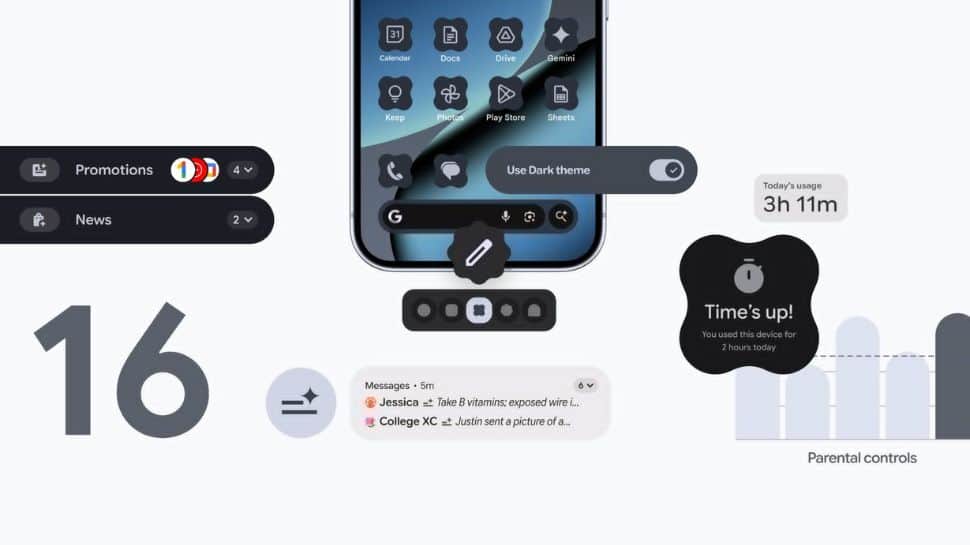
Google’s Android 16 Update For Pixel Users: Tech giant Google has rolled out the second Android 16 update of 2025, introducing new accessibility features for the first time. The update, which is first coming to Pixel devices, marks a major change in how Android updates are delivered, as the company is shifting from one yearly update to more frequent releases. The Android 16 update brings AI-powered notification tools, expanded customization options, and streamlined parental controls. Notably, the non-Pixel smartphones will receive Android 16 according to their manufacturers’ timelines. Android 16 Update For Pixel Users: What’s New Add Zee News as a Preferred Source The new Android 16 update brings several new features that make using a phone simpler and more helpful. It now includes AI-powered notification summaries that turn long messages and group chats into short, easy-to-read notes, so you don’t have to scroll through everything. There is also a new Notification Organizer that automatically groups and silences less important alerts like promotions, news, and social updates. Android 16 also gives users more ways to customize their phones with new icon shapes, themed icons, and the ability to darken apps that don’t support dark mode. For families, a new Parental Controls section in Settings lets parents manage their child’s phone use by setting daily screen time limits, controlling which apps can be used, and creating bedtime schedules. These controls are protected by a PIN and can be managed directly from the child’s device. Overall, Android 16 makes phones easier to use, more personal, and safer for kids. (Also Read: YouTube ‘Recap’ Feature Launched: Check Top Trends, Podcasts, Songs, And Most-Watched Creators of 2025; Here’s How To View It) Google’s New Android Features Google is also introducing some new Android features that work even if you are not using Android 16. One of them is a beta feature called “Call Reason,” which lets you mark a call to your saved contacts as “urgent,” so they know it’s important. Another new feature is “Expressive Captions,” which adds emotion tags like (sad) or (joyful) to video messages or social media posts, helping you understand the tone of what someone is saying. Chrome Gets Smarter With Better Pinned Tabs Google has also improved Chrome by making pinned tabs work just like they do on a computer, so your favorite pages stay at the front and are easy to return to. The “Circle to Search” tool is also getting better, allowing you to search anything on your screen by circling, highlighting, scribbling, or tapping. And now, you don’t even need to touch your phone to use Voice Access. You can simply say, “Hey Google, start Voice Access,” and control your phone with your voice.

Redmi 15C 5G Launched In India With 6,000mAh Battery; Check Camera, Processor, Display, Price And Sale Date | Technology News
Redmi 15C 5G Price In India: Xiaomi has launched the Redmi 15C 5G smartphone in the Indian market, a day after Vivo introduced the Vivo X300 series in the country. The smartphone runs Android 15 with Xiaomi HyperOS 2 and will receive 2 years of software updates and 4 years of security updates. The Redmi 15C 5G arrives as a budget handset and the successor to the Redmi 14C, which was introduced in January this year. It comes in Midnight Black, Moonlight Blue, and Dusk Purple colour options. The smartphone is offered in 4GB RAM + 128GB, 6GB RAM + 128GB and 8GB RAM + 128GB storage variants. Redmi 15C 5G Specifications Add Zee News as a Preferred Source The smartphone features a 6.9-inch HD+ (720 × 1,600 pixels) AdaptiveSync display with a 120Hz refresh rate and 240Hz touch sampling rate for smooth visuals and responsive touch. It is powered by a 6,000mAh battery that supports 33W fast charging. The phone measures 171.56 × 79.47 × 8.05mm and weighs 211g. On the photography front, the smartphone supports a 50MP AI dual rear camera with an f/1.8 aperture, along with an 8MP front camera for selfies and video calls. On the connectivity front, the smartphone supports 5G, 4G, Wi-Fi, Bluetooth 5.4, GPS, and a USB Type-C port. (Also Read: OPPO A6x 5G Launched In India With MediaTek Dimensity 6300 Chipset; Check Camera, Battery, Display, Price, Availability And Other Features) Redmi 15C 5G Price In India And Sale Date The Redmi 15C 5G starts at Rs 12,499 for the base model with 4GB RAM and 128GB storage. It also comes in 6GB and 8GB RAM variants, priced at Rs 13,999 and Rs 15,499. The phone will be available for purchase on Amazon and the Xiaomi India website starting December 11.

Privacy Regulator Demands Coupang Re-Notify Users Of Data Breach | Technology News
Seoul: The data protection regulator here said on Wednesday that e-commerce giant Coupang Inc. did not properly notify its customers of its recent major data breach, demanding a corrected notification of a personal information “leak” from an “exposure” of such data. The Personal Information Protection Commission (PIPC) made the decision in an emergency meeting after the company said last week personal information of 33.7 million customers had been compromised, including names, addresses and phone numbers, reports Yonhap news agency. While Coupang notified affected users of the breach, the PIPC said the company merely described it as personal information being exposed when it was aware that such data had been leaked. Add Zee News as a Preferred Source The regulator said Coupang also partially omitted types of data affected while announcing the breach on its website for just one to two days. It ordered the company to notify affected customers again of the leak, advise them of data protection measures, such as changing passwords, and reinspect steps to prevent harm to customers, among other measures. It demanded Coupang submit the results of its measures within one week. “(We) will swiftly and thoroughly investigate the circumstances, scope and items of Coupang’s personal information leak, as well as violations of safety duties, and will make strict punishment if violations are found,” it said in a release. Meanwhile, the regulator said it strengthened the monitoring of illegal distribution of personal information on the internet and the dark web Sunday, which will last for three months. Coupang is facing a wave of class-action lawsuits over its massive data breach that affected nearly 34 million customers. A law firm named Chung filed the first complaint against Coupang on Monday on behalf of 14 clients, seeking 200,000 won (about US$140) per person in damages. Many other law firms have also expressed their intention to participate in the class-action lawsuits and are now recruiting participants. Considering past judicial precedents, however, the compensation awarded to users whose personal information was leaked was around 100,000 won per person, legal experts said on Wednesday.

Redmi 14C 5G Launched In India With 6,000mAh Battery; Check Camera, Processor, Display, Price And Sale Date | Technology News
Redmi 14C 5G Price In India: Xiaomi has launched the Redmi 14C 5G smartphone in the Indian market, a day after Vivo introduced the Vivo X300 series in the country. The smartphone runs Android 15 with Xiaomi HyperOS 2 and will receive 2 years of software updates and 4 years of security updates. The Redmi 14C 5G arrives as a budget handset and the successor to the Redmi 14C, which was introduced in January this year. It comes in Midnight Black, Moonlight Blue, and Dusk Purple colour options. The smartphone is offered in 4GB RAM + 128GB, 6GB RAM + 128GB and 8GB RAM + 128GB storage variants. Redmi 14C 5G Specifications Add Zee News as a Preferred Source The smartphone features a 6.9-inch HD+ (720 × 1,600 pixels) AdaptiveSync display with a 120Hz refresh rate and 240Hz touch sampling rate for smooth visuals and responsive touch. It is powered by a 6,000mAh battery that supports 33W fast charging. The phone measures 171.56 × 79.47 × 8.05mm and weighs 211g. On the photography front, the smartphone supports a 50MP AI dual rear camera with an f/1.8 aperture, along with an 8MP front camera for selfies and video calls. On the connectivity front, the smartphone supports 5G, 4G, Wi-Fi, Bluetooth 5.4, GPS, and a USB Type-C port. (Also Read: OPPO A6x 5G Launched In India With MediaTek Dimensity 6300 Chipset; Check Camera, Battery, Display, Price, Availability And Other Features) Redmi 14C 5G Price In India And Sale Date The Redmi 15C 5G starts at Rs 12,499 for the base model with 4GB RAM and 128GB storage. It also comes in 6GB and 8GB RAM variants, priced at Rs 13,999 and Rs 15,499. The phone will be available for purchase on Amazon and the Xiaomi India website starting December 11.
YouTube ‘Recap’ Feature Launched: Check Top Trends, Podcasts, Songs, And Most-Watched Creators of 2025; Here’s How To View It | Technology News
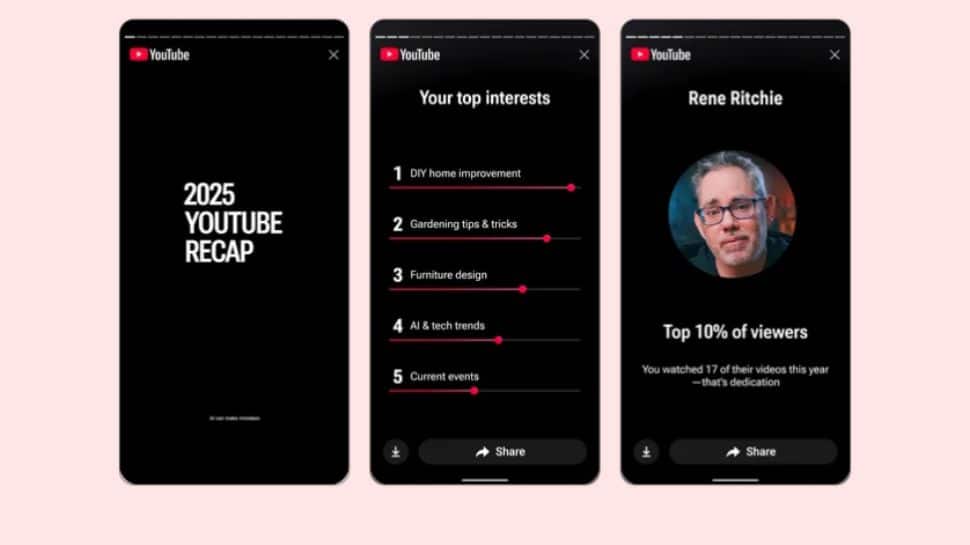
YouTube ‘Recap’ Feature: Google-owned platform has launched the first full version of YouTube ‘Recap’ feature, a personalized shareable highlight reel that sums up everything you watched throughout the year in 2025. The company’s this move clearly aimed at taking on Apple Music Replay and Spotify Wrapped. Meanwhile, the YouTube also released its annual lists of top trends, creators, songs, and podcasts that shaped the platform in 2025. Notably, the YouTube Recap feature is currently available for users in North America, with a global rollout scheduled for later this week. YouTube added this feature after nine rounds of feedback and testing more than 50 different concepts. The new feature works across both mobile and desktop. What Is YouTube ‘Recap’ Feature? Add Zee News as a Preferred Source YouTube Recap serves as a snapshot of everything users consumed on the platform throughout 2025. Recap, according to YouTube, is basically a synopsis of your 2025 viewing habits. YouTube ‘Recap’ Feature: What’s Waiting Inside For You Users will get up to 12 cards that show their favourite channels, topics, and how their watching habits changed during the year. YouTube will also give each user a personality type based on the videos they watched. Some examples of these personality types are Sunshiner, Wonder Seeker, and Connector. Others, like Philosopher and Dreamer, are less common. Moreover, if a user watched a lot of music, their Recap will also show their Top Artists and Top Songs of the year. YouTube has also shared charts that highlight the year’s most popular creators, podcasts, and songs. (Also Read: Downloaded Sanchar Saathi? Here’s What I Found: Permissions Needed, Features, 90-Day Deadline For Apple, Samsung, OnePlus, Vivo And How To Install App) YouTube ‘Recap’ Feature: How To View It Step 1: Open YouTube on your Android phone, iPhone, or desktop. Step 2: Sign in to your YouTube account. Step 3: On the homepage, tap the ‘You’ tab. Step 4: Right below your profile details, you’ll see a banner that says “Your Recap is here.” Step 5: If you don’t see the banner, you can still view your Recap by visiting youtube.com/Recap in a browser.
Prompt Compression for LLM Generation Optimization and Cost Reduction
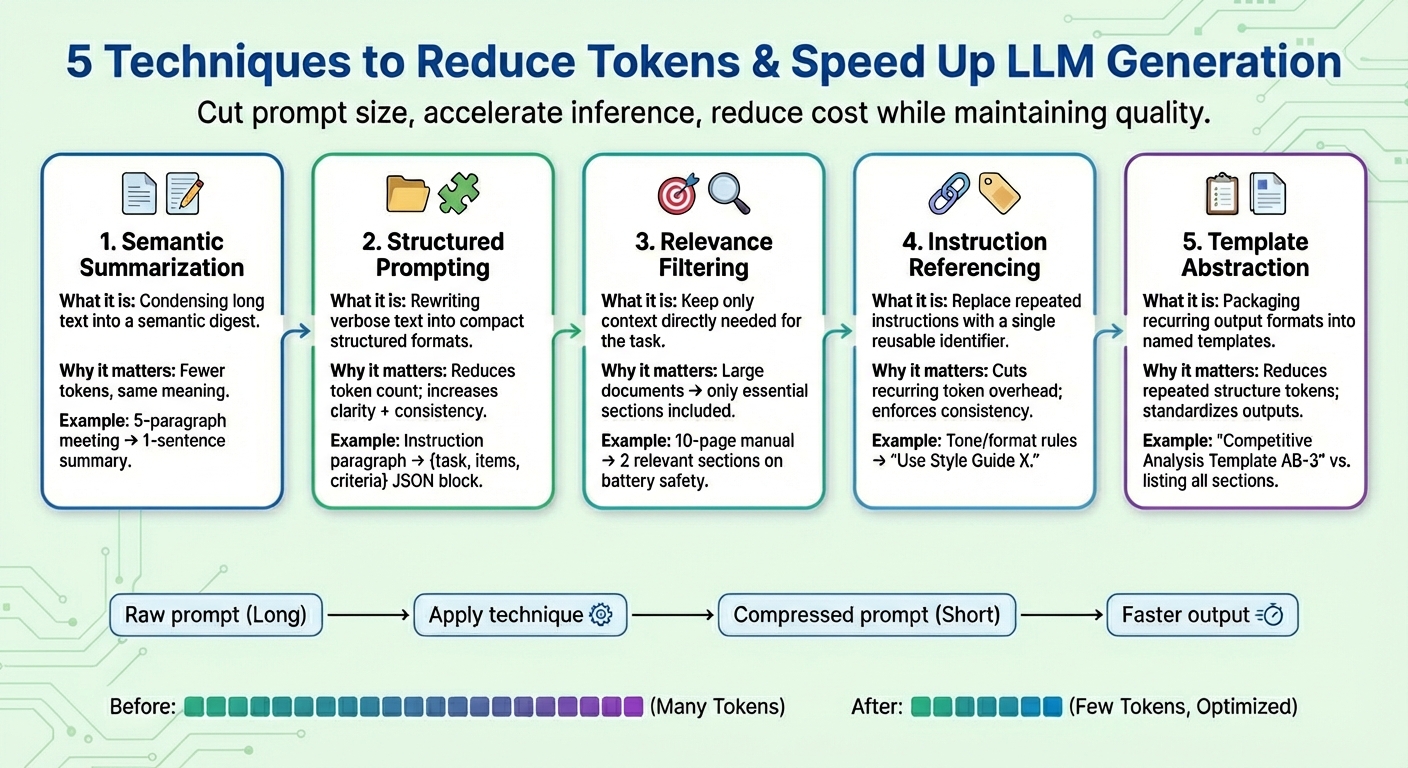
In this article, you will learn five practical prompt compression techniques that reduce tokens and speed up large language model (LLM) generation without sacrificing task quality. Topics we will cover include: What semantic summarization is and when to use it How structured prompting, relevance filtering, and instruction referencing cut token counts Where template abstraction fits and how to apply it consistently Let’s explore these techniques. Prompt Compression for LLM Generation Optimization and Cost ReductionImage by Editor Introduction Large language models (LLMs) are mainly trained to generate text responses to user queries or prompts, with complex reasoning under the hood that not only involves language generation by predicting each next token in the output sequence, but also entails a deep understanding of the linguistic patterns surrounding the user input text. Prompt compression techniques are a research topic that has lately gained attention across the LLM landscape, due to the need to alleviate slow, time-consuming inference caused by larger user prompts and context windows. These techniques are designed to help decrease token usage, accelerate token generation, and reduce overall computation costs while keeping the quality of the task outcome as much as possible. This article presents and describes five commonly used prompt compression techniques to speed up LLM generation in challenging scenarios. 1. Semantic Summarization Semantic summarization is a technique that condenses long or repetitive content into a more succinct version while retaining its essential semantics. Rather than feeding the entire conversation or text documents to the model iteratively, a digest containing only the essentials is passed. The result: the number of input tokens the model has to “read” becomes lower, thereby accelerating the next-token generation process and reducing cost without losing key information. Suppose a long prompt context consisting of meeting minutes, like “In yesterday’s meeting, Iván reviewed the quarterly numbers…”, summing up to five paragraphs. After semantic summarization, the shortened context may look like “Summary: Iván reviewed quarterly numbers, highlighted a sales dip in Q4, and proposed cost-saving measures.” 2. Structured (JSON) Prompting This technique focuses on expressing long, smoothly flowing pieces of text information in compact, semi-structured formats like JSON (i.e., key–value pairs) or a list of bullet points. The target formats used for structured prompting typically entail a reduction in the number of tokens. This helps the model interpret user instructions more reliably and, consequently, enhances model consistency and reduces ambiguity while also reducing prompts along the way. Structured prompting algorithms may transform raw prompts with instructions like Please provide a detailed comparison between Product X and Product Y, focusing on price, product features, and customer ratings into a structured form like: {task: “compare”, items: [“Product X”, “Product Y”], criteria: [“price”, “features”, “ratings”]} 3. Relevance Filtering Relevance filtering applies the principle of “focusing on what really matters”: it measures relevance in parts of the text and incorporates in the final prompt only the pieces of context that are truly relevant for the task at hand. Rather than dumping entire pieces of information like documents that are part of the context, only small subsets of the information that are most related to the target request are kept. This is another way to drastically reduce prompt size and help the model behave better in terms of focus and boosted prediction accuracy (remember, LLM token generation is, in essence, a next-word prediction task repeated many times). Take, for example, an entire 10-page product manual for a cellphone being added as an attachment (prompt context). After applying relevance filtering, only a couple of short relevant sections about “battery life” and “charging process” are retained because the user was prompted about safety implications when charging the device. 4. Instruction Referencing Many prompts repeat the same kinds of directions over and over again, e.g., “adopt this tone,” “reply in this format,” or “use concise sentences,” to name a few. Instruction referencing creates a reference for each common instruction (consisting of a set of tokens), registers each one only once, and reuses it as a single token identifier. Whenever future prompts mention a registered “common request,” that identifier is used. Besides shortening prompts, this strategy also helps maintain consistent task behavior over time. A combined set of instructions like “Write in a friendly tone. Avoid jargon. Keep sentences succinct. Provide examples.” could be simplified as “Use Style Guide X.” and then be reused when the equivalent instructions are specified again. 5. Template Abstraction Some patterns or instructions often appear across prompts — for instance, report structures, evaluation formats, or step-by-step procedures. Template abstraction applies a similar principle to instruction referencing, but it focuses on what shape and format the generated outputs should have, encapsulating those common patterns under a template name. Then template referencing is used, and the LLM does the job of filling the rest of the information. Not only does this contribute to keeping prompts clearer, it also dramatically reduces the presence of repeated tokens. After template abstraction, a prompt may be turned into something like “Produce a Competitive Analysis using Template AB-3.” where AB-3 is a list of requested content sections for the analysis, each one being clearly defined. Something like: Produce a competitive analysis with four sections: Market Overview (2–3 paragraphs summarizing industry trends) Competitor Breakdown (table comparing at least 5 competitors) Strengths and Weaknesses (bullet points) Strategic Recommendations (3 actionable steps). Wrapping Up This article presents and describes five commonly used ways to speed up LLM generation in challenging scenarios by compressing user prompts, often focusing on the context part of it, which is more often than not the root cause of “overloaded prompts” causing LLMs to slow down.
The Roadmap for Mastering Agentic AI in 2026
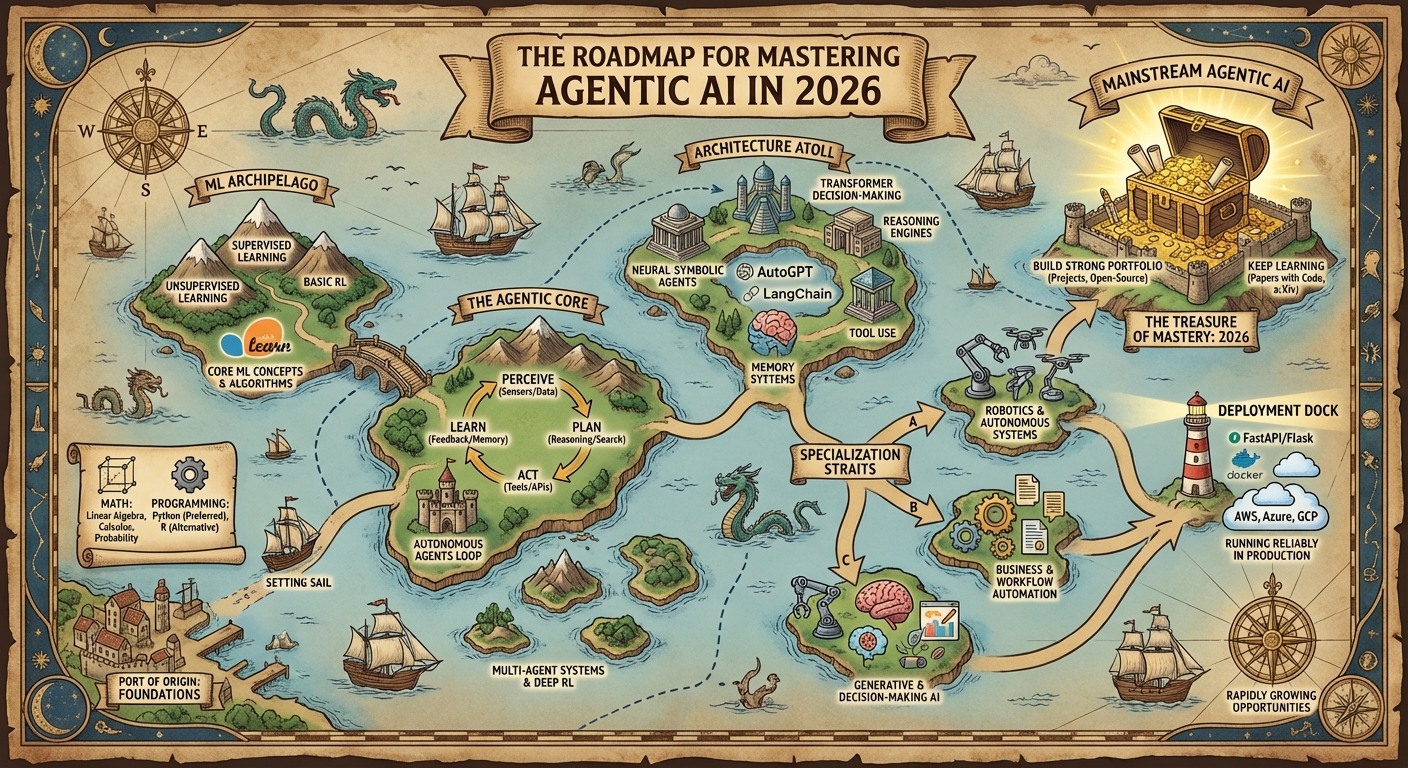
In this article, you will learn a clear, practical roadmap for mastering agentic AI: what it is, why it matters, and exactly how to build, deploy, and showcase real systems in 2026. Topics we will cover include: Core foundations in mathematics, programming, and machine learning. Concepts and architectures behind autonomous, tool-using AI agents. Deployment, specialization paths, and portfolio strategy. Let’s get right to it. The Roadmap for Mastering Agentic AI in 2026Image by Editor Introduction Agentic AI is changing how we interact with machines. Unlike traditional AI, which only reacts to commands, agentic AI can plan, act, and make decisions on its own to achieve complex goals. You see it in self-driving robots, digital assistants, and AI agents that handle business workflows or research tasks. This type of AI boosts productivity. The global AI market is growing fast, and agentic AI is expected to become mainstream by 2026. This guide gives a clear, step-by-step roadmap to master agentic AI in 2026. What Is Agentic AI? Agentic AI refers to systems that can take initiative and act independently to achieve objectives while learning from their environment. They don’t just follow instructions; rather, they plan, reason, and adapt to new situations. For example, in finance, they can adjust investments automatically, or in research, they can explore and suggest experiments independently. Step-By-Step Roadmap To Master Agentic AI In 2026 Step 1: Pre-Requisites First, you need to learn core concepts in mathematics and programming before moving on to machine learning. Learn Mathematics Build a solid understanding of the following topics:Linear Algebra: Learn vectors, matrices, matrix operations, eigenvalues, and singular value decomposition. You can learn from these YouTube courses: Calculus: Learn derivatives, gradients, and optimization techniques. You can learn from these YouTube courses: Probability and statistics: Focus on key concepts like Bayes’ theorem, probability distributions, and hypothesis testing. Helpful resources include: You can also refer to this textbook to learn the basics of mathematics needed for machine learning: TEXTBOOK: Mathematics for Machine Learning Learn Programming Now, learn the basics of programming in either one of the following languages: Python (Recommended)Python is the most popular programming language for machine learning. These resources can help you learn Python: After clearing the basics of programming, focus on libraries like Pandas, Matplotlib, and NumPy, which are used for data manipulation and visualization. Some resources that you might want to check out are: R (Alternative)R is useful for statistical modeling and data science. Learn R basics here: Step 2: Understand Key Concepts of Machine Learning At this step, you already have enough knowledge of mathematics and programming; now you can start learning the basics of machine learning. For that purpose, you should know there are three kinds of machine learning: Supervised learning: A type of machine learning that involves using labeled datasets to train algorithms with the aim of identifying patterns and making decisions. Important algorithms to learn: Linear regression, logistic regression, support vector machines (SVM), k-nearest neighbors (k-NN), and decision trees. Unsupervised learning: A type of machine learning where the model is trained on unlabeled data to find patterns, groupings, or structures without predefined outputs. Important algorithms to learn: Principal component analysis (PCA), k-means clustering, hierarchical clustering, and DBSCAN. Reinforcement learning: A category of machine learning in which an agent learns to make decisions by interacting with an environment and receiving rewards or penalties. You can skip diving deeper into it at this stage. The best course I have found to learn the basics of machine learning is:Machine Learning Specialization by Andrew Ng | Coursera It is a paid course that you can buy in case you need a certification, but you can also find the videos on YouTube:Machine Learning by Professor Andrew Ng Some other resources you can consult are: Try to practice and implement the scikit-learn library of Python. Follow this YouTube playlist for smooth learning. Step 3: Understand Autonomous Agents At the heart of agentic AI are autonomous agents that can: Perceive: Interpret input from the environment. Plan: Generate strategies to achieve goals. Act: Execute actions and interact with the world. Learn: Improve decisions based on feedback. You need to focus on topics such as multi-agent systems, goal-oriented planning & search algorithms (A*, D* Lite), hierarchical reinforcement learning, planning, and simulation environments (OpenAI Gym, Unity ML-Agents). The best resources I found to learn about autonomous agents are: Step 4: Deep Dive Into Agentic AI Architectures You need to learn to build agentic systems using simple, modern tools. You can start with neural-symbolic agents, which mix the learning ability of neural networks with basic logical reasoning. Then you can explore transformer-based decision-making, where large language models help with planning and problem-solving. Along the way, you should also understand the reasoning engine for decision-making; memory systems for handling immediate context, long-term knowledge, and experience-based learning; and the tool interface and goal management systems to connect agents to external APIs, manage tasks, and track progress. After that, try tools like AutoGPT, LangChain, and reinforcement learning with human feedback (RLHF) to create agents that can follow instructions and complete tasks on their own. The resources I found helpful are: Step 5: Choose a Specialization Agentic AI spans multiple domains. You have to pick one to focus on: Robotics & Autonomous Systems: You can dive into robot navigation, path planning, and manipulation using tools like ROS, Gazebo, and PyBullet. A few good resources to consult are: AI Agents for Business & Workflow Automation: You can work on intelligent assistants that handle research, reporting, customer queries, or marketing tasks. These agents connect different tools, automate repetitive work, and help teams make faster, smarter decisions using frameworks like LangChain and GPT APIs. Generative & Decision-Making AI: You can explore large language models that perform reasoning, planning, and multi-step problem-solving on their own. This specialization involves using transformers, RLHF, and agent frameworks to build systems that can think through tasks and generate reliable outputs. Some free resources you can consult are: Another resource that you can consult is: Multi Agent System in Artificial

Sanchar Saathi App Crosses 1.4 Crore Downloads, Helps Block 42 Lakh Mobile Devices | Technology News
Sanchar Saathi App: Since its launch on January 17 this year, the Sanchar Saathi mobile app has seen more than 1.4 crore downloads, and have successfully blocked over 42 lakh stolen or lost mobile devices, official data showed on Tuesday. While 26 lakh lost/stolen mobile phones were traced, 7.23 lakh have successfully been returned with the help of Sanchar Saathi app which is a fully voluntary, user-driven platform and privacy-first app and activates only with user consent. Sanchar Saathi app puts citizens first and protects their privacy at every step. It works only with user’s consent and gives full control over its activation and use, according to the data. Add Zee News as a Preferred Source It activates only after user chooses to register and the user may activate, deactivate, or delete it any time. The app has been designed to strengthen India’s cybersecurity without compromising privacy. Rising cyber threats have made safeguarding mobile users a pressing national concern. According to the Indian Computer Emergency Response Team (CERT-In), cybercrime incidents surged from 15,92,917 in 2023 to 20,41,360 in 2024. Digital Arrest Scams and related cybercrimes reported on the National Cyber Crime Reporting Portal alone totalled 1,23,672 in 2024, with 17,718 cases already reported by February 2025. In response to these escalating threats, the Department of Telecommunications (DoT) introduced the Sanchar Saathi mobile app — a citizen-centric tool that brings robust security features and fraud-reporting capabilities directly to users’ smartphones. The app complements the existing Sanchar Saathi portal by providing convenient, on-the-go protection against identity theft, forged KYC, device theft, banking fraud, and other cyber risks. To strengthen the initiative, the Department of Telecommunications has issued directions, mandating mobile manufacturers and importers to facilitate the availability and accessibility of the Sanchar Saathi app on devices for users in India. By empowering citizens with easy-to-use tools and real-time access to vital security features, the Sanchar Saathi mobile app represents a timely and effective response to India’s growing cybercrime challenges. The application is available in Hindi and 21 other regional languages, making it inclusive and accessible across the country. Sanchar Saathi prioritises user privacy and collects only the minimum personal information necessary to provide services.