In this article, you will learn how to build, deploy, and test a no-code document-processing AI agent with LlamaAgents Builder in LlamaCloud.
Topics we will cover include:
- How to create a document-classification agent using a natural language prompt.
- How to deploy the agent to a GitHub-backed application without writing code.
- How to test the deployed agent on invoices and contracts in the LlamaCloud interface.
Let’s not waste any more time.
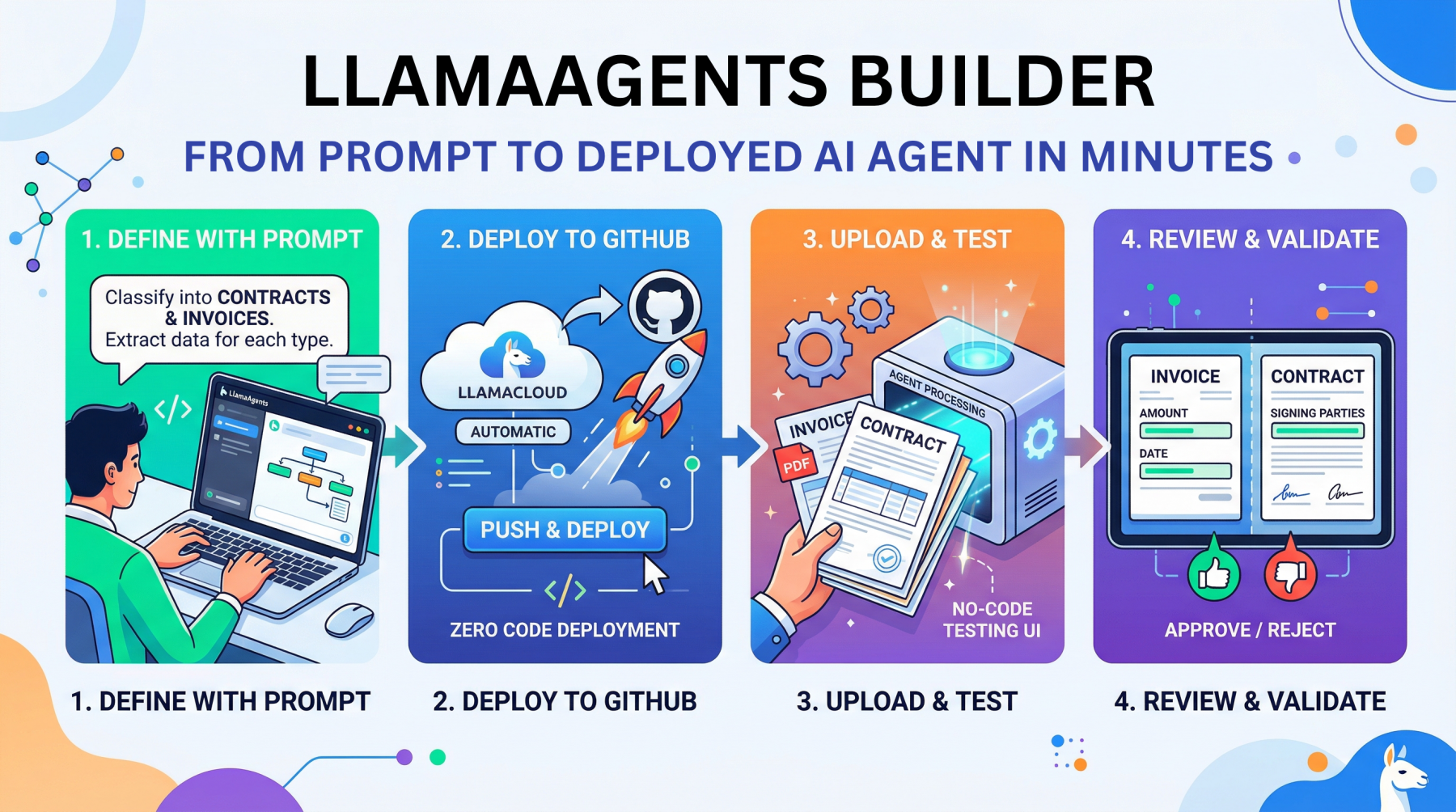
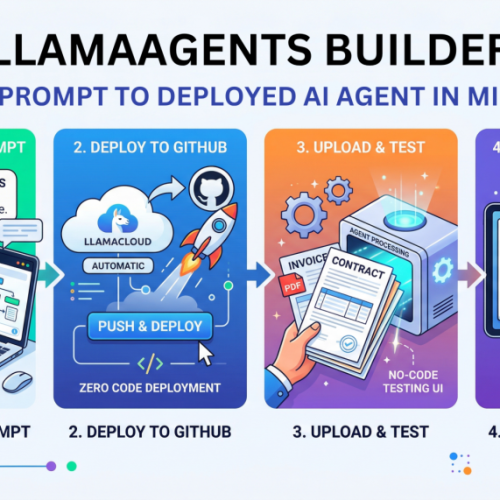
LlamaAgents Builder: From Prompt to Deployed AI Agent in Minutes (click to enlarge)
Image by Editor
Introduction
Creating an AI agent for tasks like analyzing and processing documents autonomously used to require hours of near-endless configuration, code orchestration, and deployment battles. Until now.
This article unveils the process of building, deploying, and using an intelligent agent from scratch without writing a single line of code, using LlamaAgents Builder. Better still, we will host it as an app in a software repository that will be 100% owned by us.
We will complete the whole process in a matter of minutes, so time is of the essence: let’s get started.
Building with LlamaAgents Builder
LlamaAgents Builder is one of the newest features in the LlamaCloud web platform, whose flagship product was originally introduced as LlamaParse. A slightly confusing mix of names, I know! For now, just keep in mind that we will access the agents builder through this link.
The first thing you should see is a home menu like the one shown in the screenshot below. If this is not what you see, try clicking the “LlamaParse” icon in the top-left corner instead, and then you should see this — at least at the time of writing.
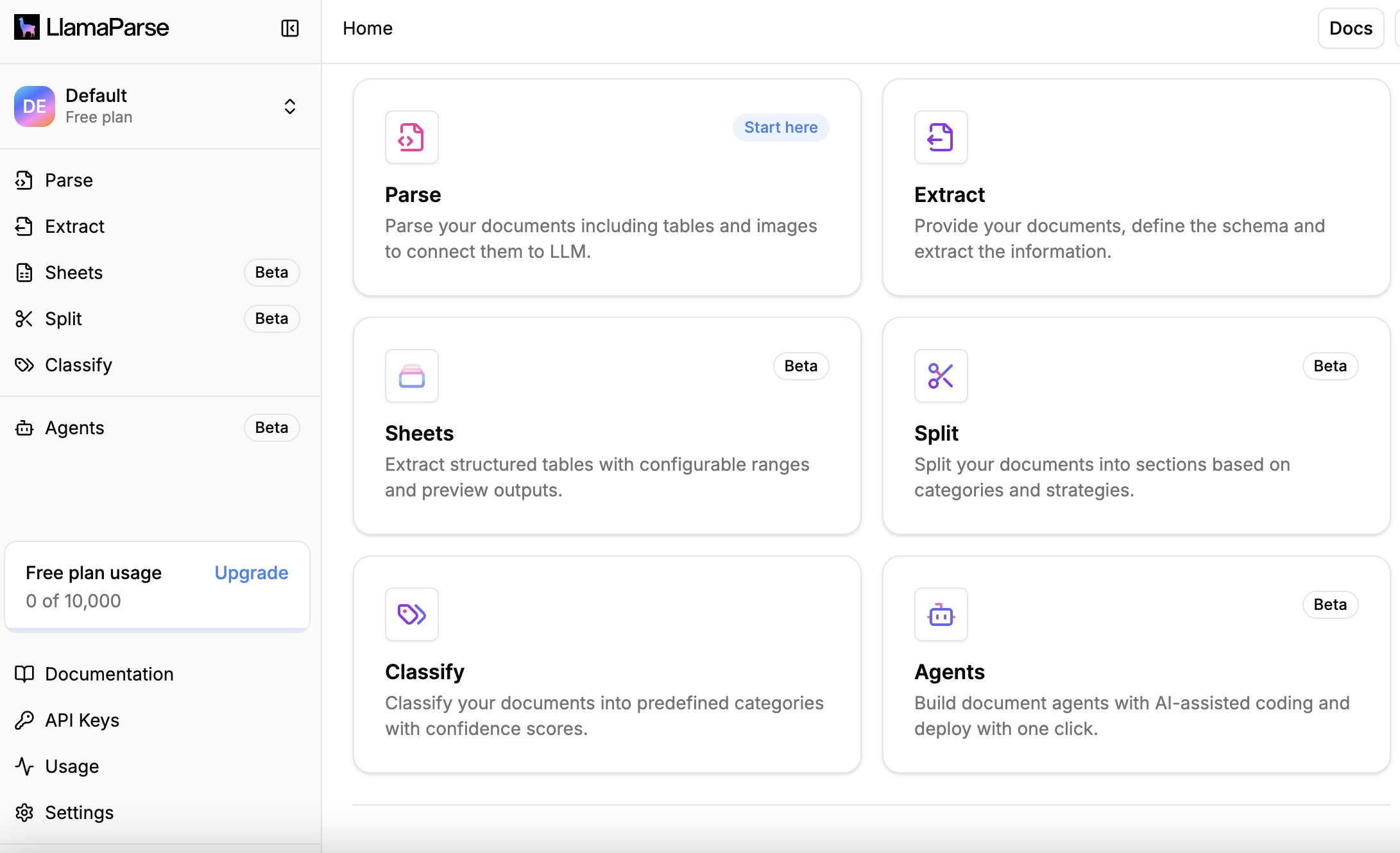
LlamaParse home menu
Notice that, in this example, we are working under a newly created free-plan account, which allows up to 10,000 pages of processing.
See the “Agents” block on the bottom-right side? That is where LlamaAgents Builder lives. Even though it is in beta at the time of writing, we can already build useful agent-based workflows, as we will see.
Once we click on it, a new screen will open with a chat interface similar to Gemini, ChatGPT, and others. You will get several suggested workflows for what you’d like your agent to do, but we will specify our own by typing the following prompt into the input box at the bottom. Just natural language, no code at all:
Create an agent that classifies documents into “Contracts” and “Invoices”. For contracts, extract the signing parties; for invoices, the total amount and date.
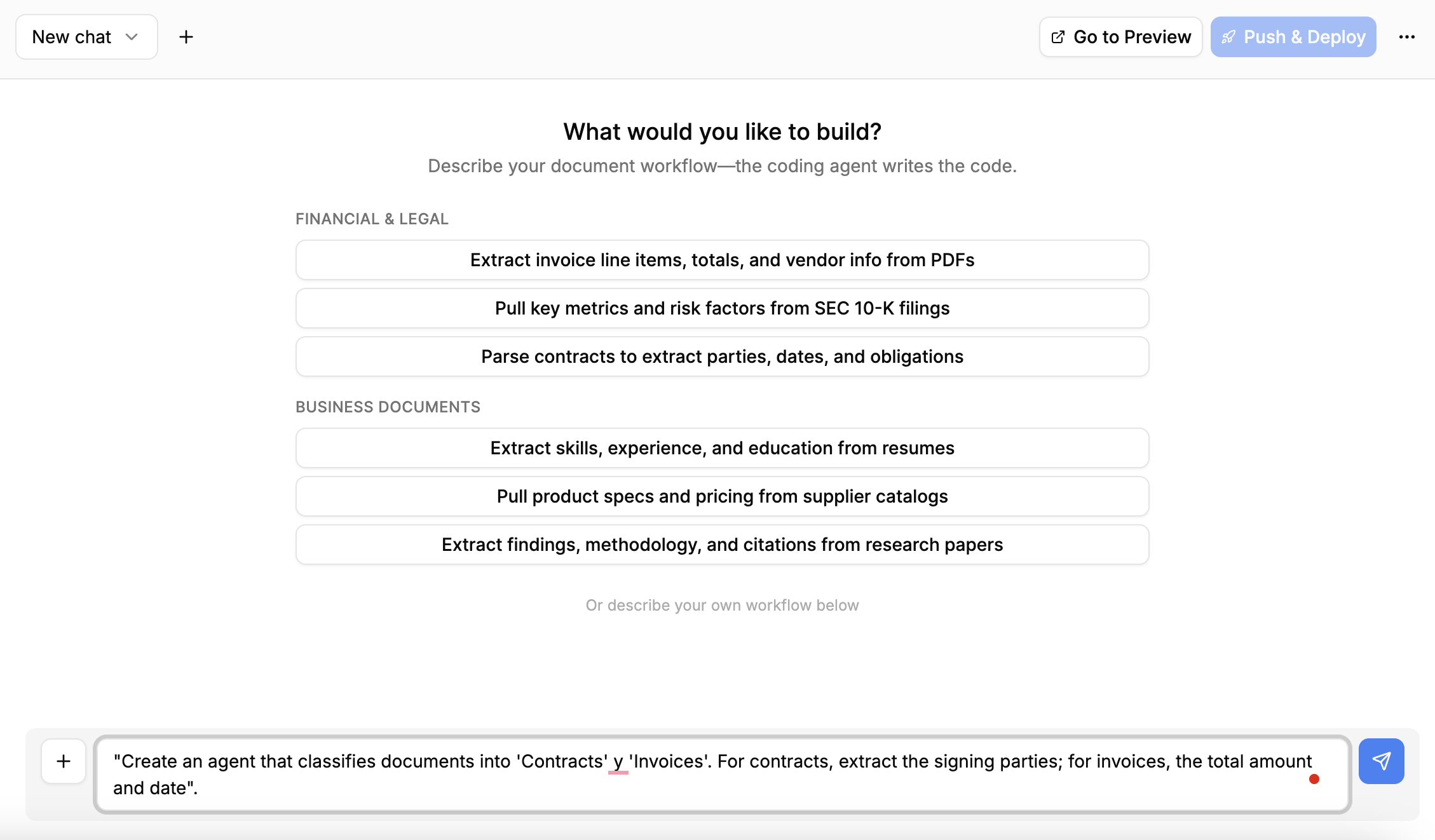
Specifying what the agent should do with a natural language prompt
Simply send the prompt, and the magic will start. With a remarkable level of transparency in the reasoning process, you’ll see the steps completed and the progress made so far:
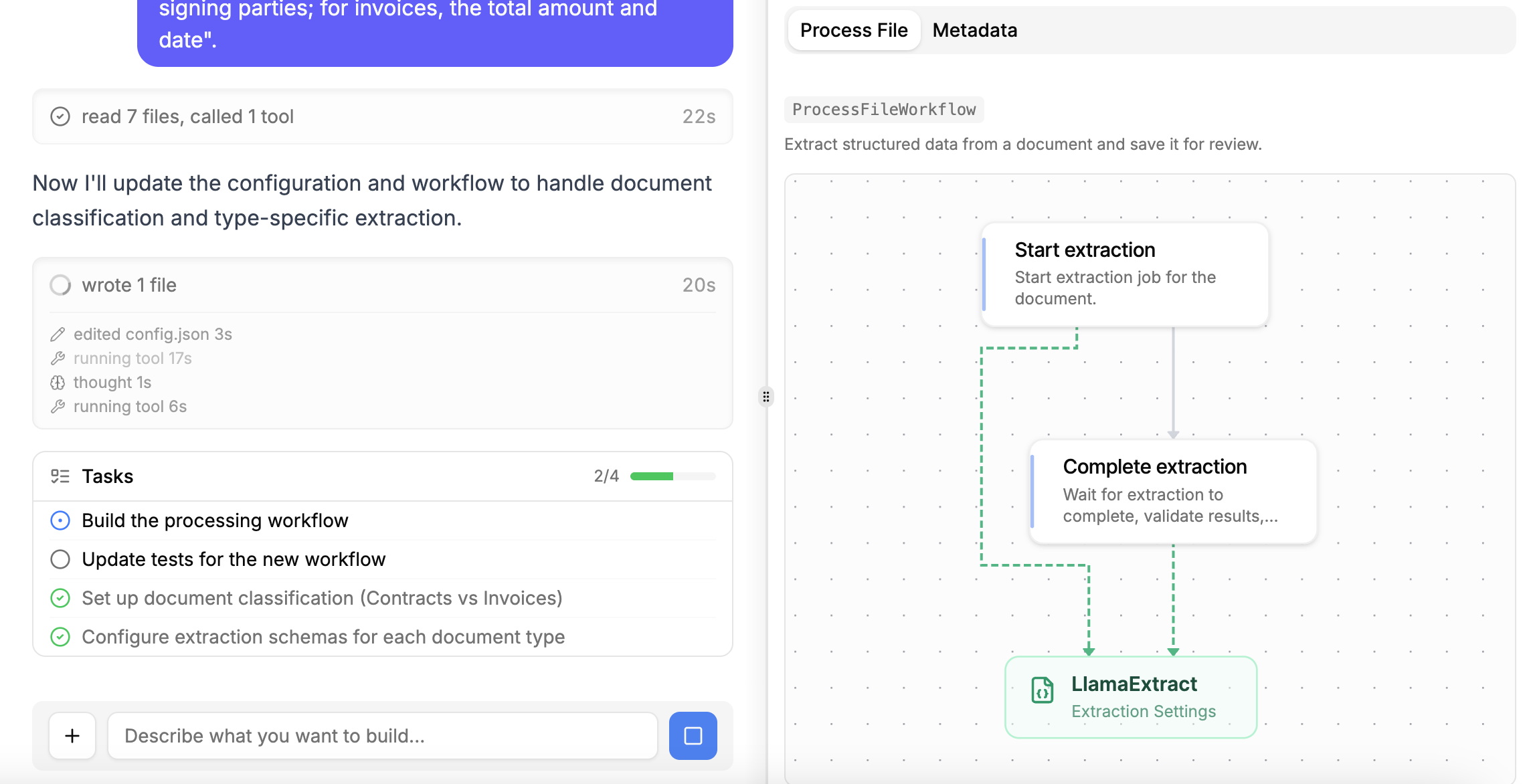
AgentBuilder creating our agent workflow
After a few minutes, the creation process will be complete. Not only can you see the full workflow diagram, which has gradually grown throughout the process, but you also receive a succinct and clear description of how to use your newly created agent. Simply amazing.
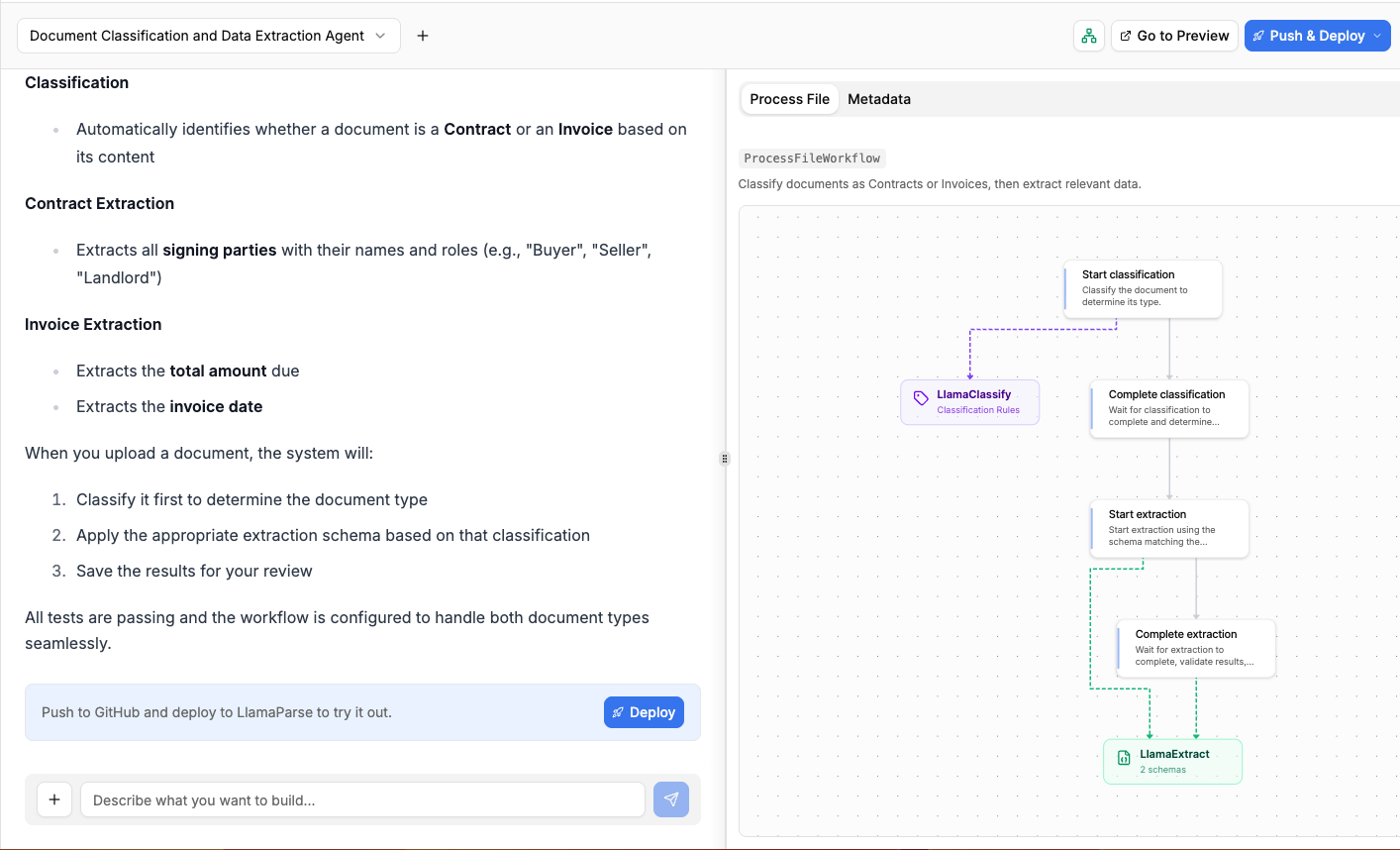
Agent workflow built
The next step is to deploy our agent so that it can be used. In the top-right corner, you may see a “Push & Deploy” button. This initiates the process of publishing your agent workflow’s software packages into a GitHub repository, so make sure you have a registered account on GitHub first. You can easily register with an existing Google or Microsoft account, for instance. Once you have the LlamaCloud platform connected to your GitHub account, it is extremely easy to push and deploy your agent: just give it a name, specify whether you want it in a private repository, and that’s it:
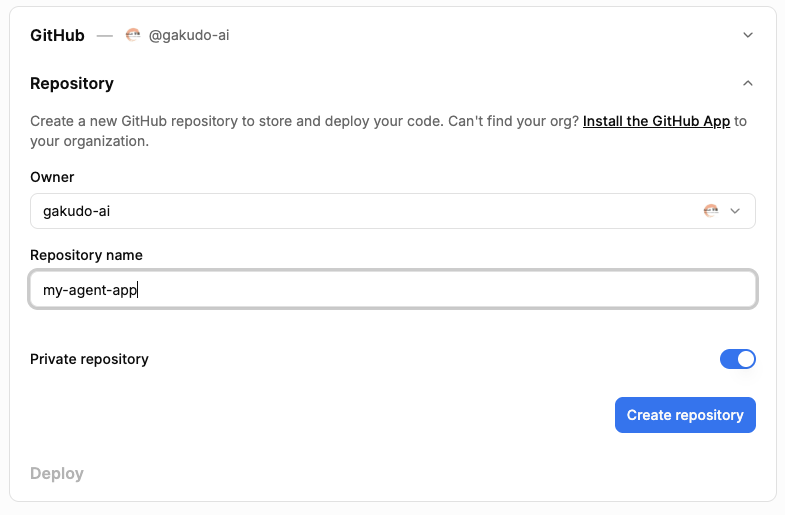
Pushing and deploying agent workflow into GitHub
The process will take a few minutes, and you will see a stream of command-line-like messages appearing on the fly. Once it is finalized and your agent status appears as “Running“, you will see a few final messages similar to this:
|
[app] 10:01:08.583 info Application startup complete. (uvicorn.error) [app] 10:01:08.589 info Uvicorn running on http://0.0.0.0:8080 (Press CTRL+C to quit) (uvicorn.error) [app] 10:01:09.007 info HTTP Request: POST https://api.cloud.llamaindex.ai/api/v1/beta/agent-data/:search?project_id=<YOUR_PROJECT_ID_APPEARS_HERE> “HTTP/1.1 200 OK” (httpx) |
The “Uvicorn” messages indicate that our agent has been deployed and is running as a microservice API within the LlamaCloud infrastructure. If you are familiar with FastAPI endpoints, you may want to try it programmatically through the API, but in this tutorial, we will keep things simpler (we promised zero coding, didn’t we?) and try everything ourselves in LlamaCloud’s own user interface.
To do this, click the “Visit” button that appears at the top:

Deployed agent up and running
Now comes the most exciting part. You should have been taken to a playground page called “Review,” where you can try your agent out. Start by uploading a file, for example, a PDF document containing an invoice or a contract. If you don’t have one, just create a fictitious example document of your own using Microsoft Word, Google Docs, or a similar tool, such as this one:
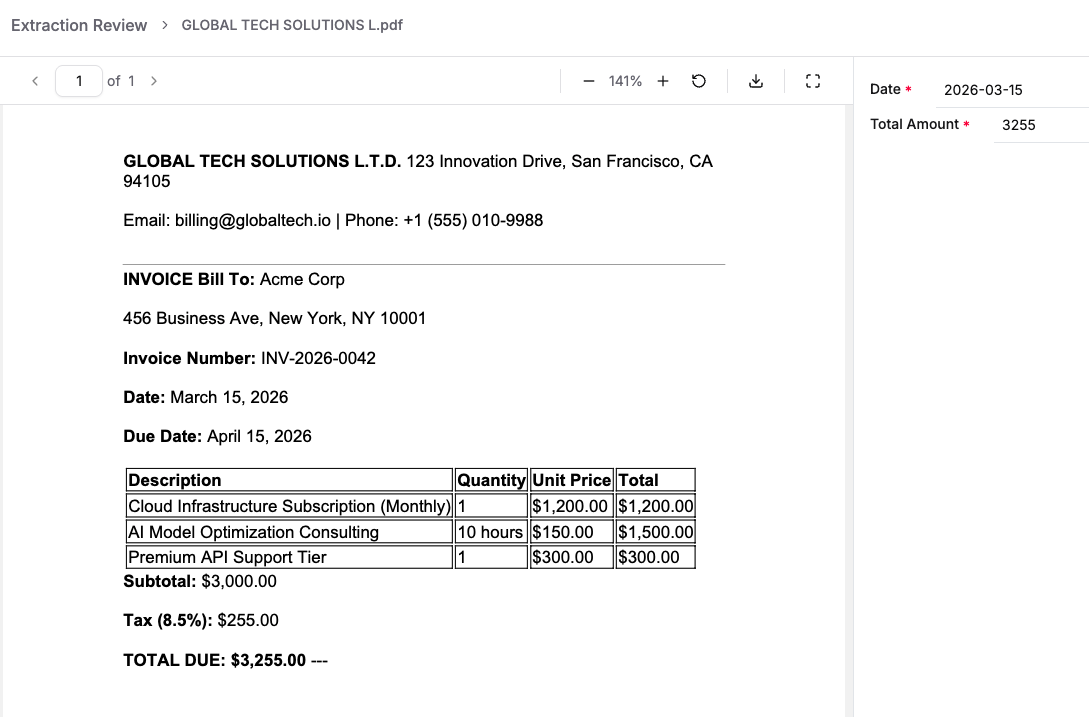
LlamaCloud Agent Testing UI: processing an invoice
As soon as the document is loaded, the agent starts working on its own, and in a matter of seconds, it will classify your document and extract the required data fields, depending on the document type. You can see this result on the right-hand-side panel in the image above: the total amount and invoice date have been correctly extracted by the agent.
How about uploading an example document containing a contract now?
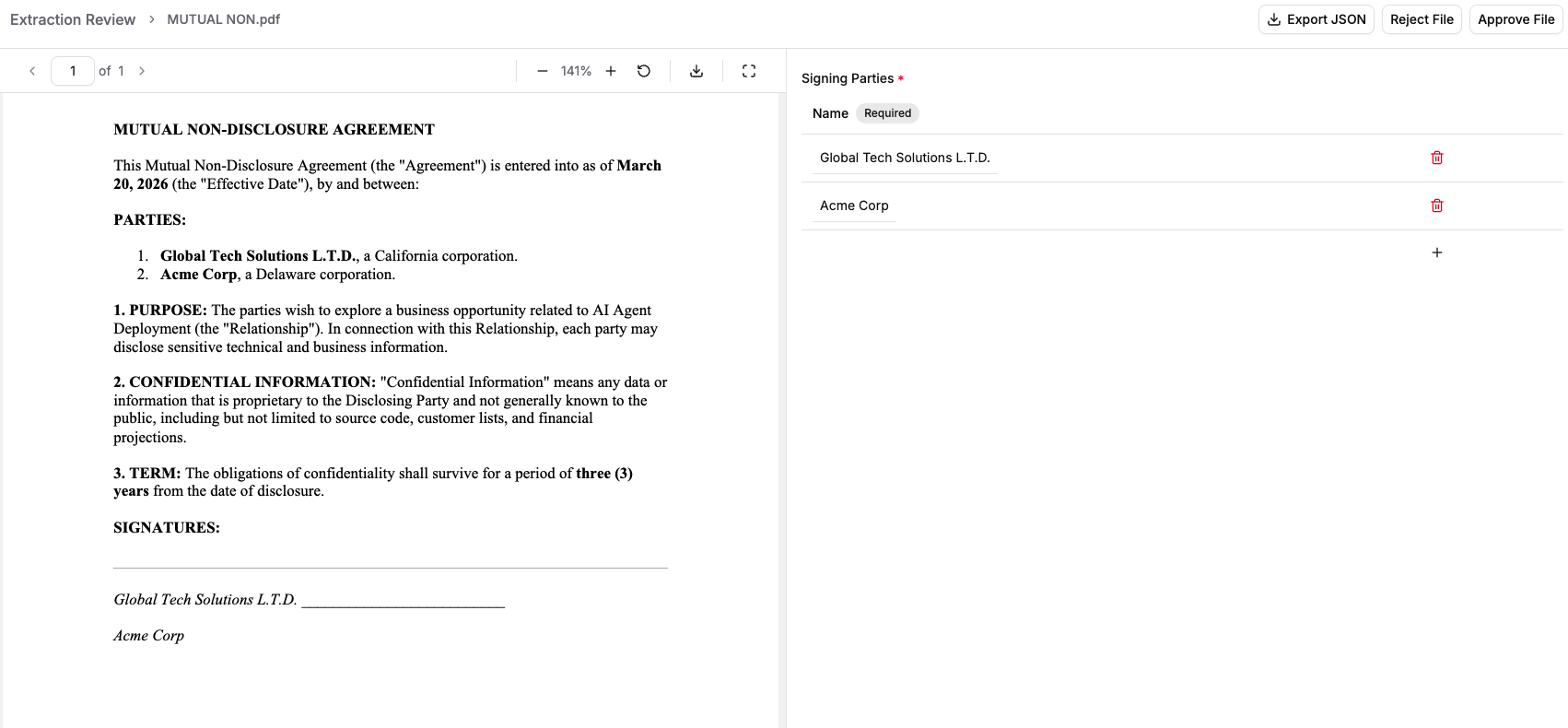
LlamaCloud Agent Testing UI: processing a contract
As expected, the document is now classified as a contract, and on this occasion, the extracted information consists of the names of the signing parties.
Well done! As you keep running examples, make sure you approve or reject them based on whether they have been processed correctly: this helps the agent learn from feedback.
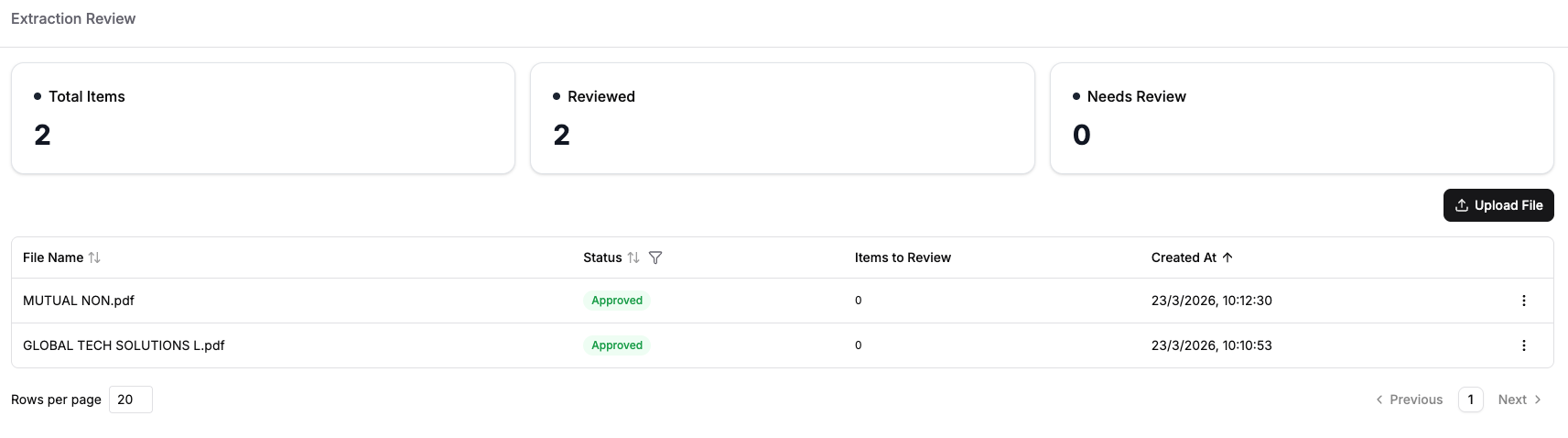
Agent testing cases and their status
Wrapping Up
We have seen how to build and deploy, step by step and with no lines of code, an AI agent capable of classifying documents and processing them in different ways depending on the document type — all in a matter of minutes and within LlamaCloud’s newly added feature, LlamaAgents Builder.