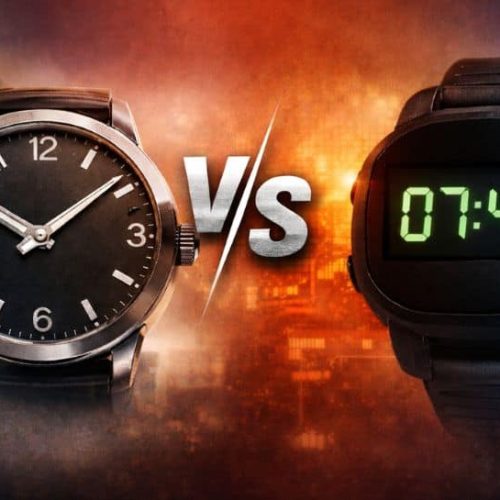
Analog vs digital watches: In today’s fast-moving world, telling time accurately is very important for work, travel, and daily life. Many people still debate whether an analog watch or a digital watch tells the exact time more precisely. Both types are widely used, but they work in slightly different ways.
An analog watch shows time using hour, minute, and sometimes second hands on a numbered dial. Traditional mechanical analog watches rely on gears and springs to keep time. However, quartz analog watches use a battery and a quartz crystal to maintain accuracy.
Mechanical watches can lose or gain a few seconds each day due to movement and temperature changes. Quartz analog watches are generally more accurate because the quartz crystal vibrates at a steady frequency when powered by a battery.
Add Zee News as a Preferred Source

A digital watch displays time in numbers, usually in hours, minutes, and seconds. Most digital watches also use quartz technology. The time is shown electronically on an LCD or LED screen.
Because digital watches use quartz movement, their accuracy is usually similar to that of quartz analog watches. Many digital watches also include features like alarms, stopwatches, and automatic time updates.
Which one is more accurate?
In general, accuracy does not depend on whether a watch is analog or digital. It depends on the movement inside the watch. Both analog and digital quartz watches are usually accurate to within a few seconds per month.
Mechanical analog watches are less accurate compared to quartz watches and may require regular adjustment. Some advanced digital watches connected to GPS or radio signals can automatically sync with official time standards, making them extremely precise.
If you want the most exact time, a quartz-based or GPS-enabled digital watch may offer better precision. However, a quartz analog watch can be just as accurate for everyday use. The choice depends on personal preference, style, and comfort rather than accuracy alone.